Thomas Henrik Andersen
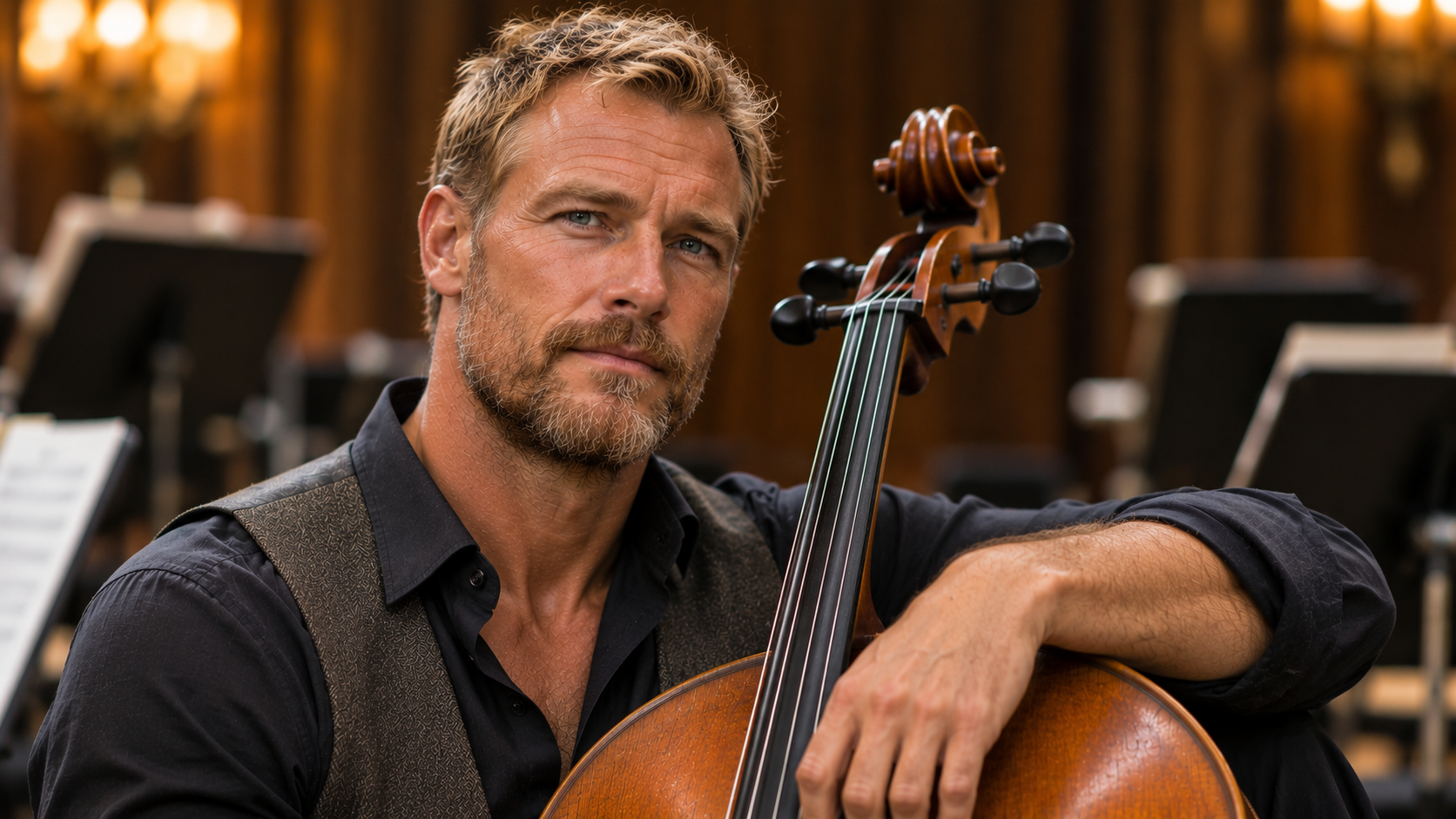
Thomas Henrik Andersen was the cellist of The Tasman Strings and a long-serving member of the Tasmanian Symphony Orchestra's cello section. The grandson of a Danish boatbuilder in Kingston, he chose the cello over the family yard and never quite settled the debt. In 1996 he coaxed Daniel Harris back to the piano. In the quartet he held everyone together from underneath, and on the night Elizabeth Harris died he was the one who made the calls.
The Boatbuilder's Grandson
Thomas Henrik Andersen was born on 19 February 1970 at the Royal Hobart Hospital, the elder of two children of Erik and Helen Andersen. His grandfather, Henrik Andersen, had come out from Svendborg on the Danish island of Funen in 1926 with a set of shipwright's tools and very little English, and by the outbreak of the Second World War he had built a slipway and a timber shed at the mouth of Browns River in Kingston. Henrik built clinker dinghies, fishing boats and the occasional yacht for a Hobart doctor or lawyer, and he built them slowly, in Huon pine and celery-top, the way he had been taught as a boy.
Erik grew up in the shed and took over the yard in the early 1960s. He married Helen Cartledge, a bookkeeper from Sorell who ran the yard's accounts from the kitchen table for the next thirty years. Thomas's sister, Lise, was born in 1973. The family lived in a weatherboard house above the slipway, close enough to hear the tide against the cradle at night, and Thomas spent his childhood sweeping shavings, sorting copper roves and learning the names of every tool on the wall before he could read the labels on them.
Everyone assumed the yard would be his. Erik assumed it most of all. He was a hard, fair, taciturn man who showed affection by giving his son jobs, and by the time Thomas was ten he could steam a rib, fair a plank and hold a dolly against a rivet without flinching. He was already large for his age, slow to speak and very hard to rattle. Henrik, who lived in a cottage at the back of the yard and spoke Danish to anyone who would put up with it, called him the little ox.
A Cello in the Wrong House
The cello arrived by accident. At twelve, in his first year at Kingston High School, Thomas was put into the school's instrumental programme because a cello had been returned and nobody else in his class was big enough to hold it. The visiting teacher was Bernard Fitch, a retired cellist from the Tasmanian Symphony Orchestra who gave lessons in a converted garage in Blackmans Bay and smoked a pipe throughout them. Within a term Fitch had rung the Andersen house to say the boy had an unusual ear and should be practising an hour a day.
Erik did not forbid it, but he did not understand it either. Practice took time from the yard, and Thomas's hands, Erik said more than once, were worth more on a plank than on a fingerboard. Helen kept the peace by driving Thomas to Blackmans Bay on Saturday mornings and saying nothing about it at dinner. It was Henrik who settled the matter. He came to hear Thomas play at a school concert in 1984, sat in the front row in his good jacket and wept openly through a Saint-Saëns slow movement that Thomas played at roughly half the right speed.
Henrik died the following winter. He left Thomas enough money to buy a proper instrument, a nineteenth-century German cello that Bernard Fitch found through a dealer in Melbourne, with a note in his will saying that a boat and a cello were both made of wood and that the boy could choose. Erik read the will twice and never mentioned it again. Thomas understood that he had been given permission by one man and refused it by another, and he spent a good part of his adult life trying not to choose between them.
Davey Street and the Back Desks
Thomas finished school at Hobart Matriculation College and entered the Tasmanian Conservatorium of Music in 1988. He worked in the yard every weekend through his student years, partly for money and partly because he could not bear to let his father think he had left it. His teachers at the Conservatorium found him reliable rather than brilliant. He had a big, warm, unhurried sound and an instinct for where the bass line wanted to go, and he was more interested in playing with other people than in playing alone. He graduated in 1991 and the orchestra took him on as a casual in the cello section that winter.
He was given a permanent chair in 1992, at the back of the section, and he worked his way forward over the next decade without ever seriously competing for the principal's position. He disliked auditions, disliked solos and was content, as he put it to his sister, to be one of the people holding up the floor. The orchestra's touring buses suited him. He slept through most of them, woke at every country hall to help the stage crew unload, and earned a reputation as the man who would carry anything for anyone.
In 1993 he met Rachel Lennox, a primary school teacher from Margate, at a friend's barbecue on the Channel. She was small, quick, sharp-tongued and entirely unimpressed by orchestras, and he liked her for all four reasons. They were married in 1995 in the Uniting church at Kingston, with a reception in the boat shed among the cradles, and settled in a brick house on the hill above Kingston Beach, within sight of the slipway.
The Yard Is Sold
Erik Andersen had a heart attack in 1994, at fifty-six, while lifting a mast. He recovered, but he could no longer do the heavy work, and the question of the yard's future became one nobody could avoid. Thomas offered to run it part-time alongside the orchestra. Erik refused. He said, with a bitterness that surprised them both, that a boatyard was not a hobby, and in 1997 he sold the site to a developer who wanted it for a marina. Henrik's shed was pulled down that summer.
Thomas did not go to watch it come down. He kept a few of his grandfather's tools, a wooden plane, a bevel gauge and a set of caulking irons, and stored them in his garage for almost thirty years without using them. Father and son were reconciled in the ordinary way, without discussion, and Erik came to hear the orchestra more often in his last years than he had in his son's first twenty. He died in 2009. At the funeral Thomas played the sarabande from Bach's fifth cello suite and afterwards stood by the water at Browns River for an hour, alone.
Rachel and Thomas had two children, Freya in 1997 and Jakob in 2000. Freya was clever, organised and impatient with Kingston, and left for architecture school in Sydney at eighteen. Jakob was harder. He was a restless, unhappy teenager who left university after a year, drifted through jobs on the salmon farms in the Huon and for several years spoke to his father only when he needed something. Thomas's patience, which was considerable, was tested more by his son than by anyone in an orchestra.
The Cellist Who Asked
In 1996 Thomas was preparing a recital of cello sonatas for a lunchtime series at the Conservatorium and needed a pianist. He had heard about Daniel Harris, the son of the orchestra's first violinist Robert Harris, who had walked off the stage in the middle of an international piano competition two years earlier and had barely played in public since. One afternoon Thomas heard someone playing Brahms alone in an empty practice room on Davey Street and stood outside the door for twenty minutes. When Daniel came out, Thomas asked him to play the Brahms E minor sonata with him.
Daniel said no twice before he said yes. The recital was small and unremarkable to everyone in the audience except the two players. It was the first time Daniel had played in public since his collapse, and it led, within two years, to his work as a repetiteur and then as the orchestra's rehearsal pianist. Daniel never forgot who had asked. The two men stayed friends for the rest of their lives, in the undemonstrative way Thomas conducted all his friendships, and Thomas played at Daniel's wedding to Elizabeth Chen in 2005.
The friendship had a cost Thomas rarely mentioned. Robert Harris had been estranged from his son since the collapse, and for several years he regarded Thomas's involvement with suspicion, as though the cellist had taken a side. It was not until Daniel joined the orchestra's staff that Robert began to speak to Thomas with any warmth. Thomas bore the coolness without complaint. He had grown up with a father who could not say what he felt, and he recognised the type.
Trying It for a Year
When Elizabeth Harris asked Thomas in early 2010 to play cello in the string quartet she was forming, he said he would try it for a year. He was forty, the oldest of the four by five years, and he had two children at school, a mortgage and a bad back. He also had a deep fondness for Elizabeth, whom he had first met as Daniel's fiancée, and a suspicion that a quartet led by her would be exhausting. He was right about that, and he stayed for the rest of the quartet's life.
It was Thomas who settled the argument about the name, by observing that The Tasman Strings would look well on a wedding invitation, and it was Thomas who made most of the arrangements the quartet played at weddings. He wrote them at his kitchen table in Kingston after the children had gone to bed, pop songs and film themes and the inevitable Pachelbel, in neat pencil on manuscript paper. He did not care for the weddings themselves and never once complained about playing them, because he knew they paid for everything else.
In rehearsals he held the quartet together from underneath. When Elizabeth and Amelia argued, which they did often in the early years, Thomas waited until they had finished and then suggested they play the passage again. Afterwards he would find whichever of them was more upset and talk to her in the car park until she was ready to drive home. Robert Harris, watching from his armchair at Fitzroy Place, told Thomas privately that he was the only one of the four who knew what a quartet was for.
The Waiting Year and After
When James O'Sullivan smashed his left hand in the south-west in 2011 and Elizabeth refused to replace him, Thomas supported her against nearly everyone, Robert included. Through that year the three of them took what work they could as a string trio, and Thomas drove to West Moonah most weeks to sit with James, usually without bringing up music at all. He was not a talker. He would make a pot of tea, sit at the kitchen table and stay for two hours, and James said later that those silent afternoons did more for him than the psychologist.
The school tours of the middle of the decade gave Thomas the work he enjoyed most. He would set up in front of two hundred children sitting cross-legged on a hall floor in the north-west or on the east coast and explain the cello to them, letting the smallest ones pluck the C string and feel it buzz through the floorboards. He was better at it than any of the others, and he knew why. He had been one of those children, in a school hall in Kingston, given an instrument nobody else wanted.
His back gave way in the summer of 2017, after thirty years of carrying a cello and a body built for a boatyard. He had surgery on two discs that autumn and was out of the orchestra for four months. He came back in time to record Southern Echoes, sitting on a specially built stool, and he played through the long rehearsals for Songs of Country the following year with a hot-water bottle strapped to his lower back under his jumper. Nobody in the audience knew.
The Quiet Years
The quartet's middle years were the most settled of Thomas's life. Freya married in Sydney in 2019 and the quartet played at the wedding, which Thomas regarded as the best use of a wedding arrangement he had ever made. That same year he noticed that Elizabeth was distracted and short-tempered for several weeks, and assumed, as James did, that something was wrong at home. He did not ask. He learned only after her death, from Amelia, that she had been offered and had turned down the leadership of a quartet in Melbourne.
The pandemic of 2020 cost the quartet almost all its work. Thomas missed the others more than he had expected to, and he was among the first to suggest they rehearse outdoors when the rules allowed, in a garden in Sandy Bay in coats and fingerless gloves. When they recorded Nightfall later that year in the empty Federation Concert Hall, he remarked that it was the only time in his life he had played in that hall and heard nothing at all from the seats. It was the most anyone had heard him say about the experience.
His mother, Helen, died in 2022, after several years of dementia in a nursing home in Kingston where Thomas visited every Tuesday and played to the residents in the common room. In November 2023 the quartet played the early set at the housewarming party at Jeffries Manor and drove home before the jazz trio had finished its first number. Thomas drove. He remembered Elizabeth asleep in the back seat with her violin case on her knees.
The Calls
On the evening of 15 March 2024, a little before nine o'clock, Daniel Harris rang Thomas from the house in West Hobart. Two police officers had been at the door twenty minutes earlier to tell him that Elizabeth had been killed on the Midland Highway north of Kempton, driving home from Launceston. Daniel had rung her parents. He could not ring anyone else, and he rang Thomas because Thomas was the person he had always rung.
Thomas made the other calls. He rang James first, at home in West Moonah, and then Amelia, who was at her birthday dinner at her mother's house in Sandy Bay. He did it in his own kitchen, standing up, with Rachel holding his arm, and he kept his voice level throughout both calls. Then he drove to West Hobart and sat with Daniel and the children until two in the morning. At the funeral at St David's Cathedral on 26 March he played beside the empty chair and did not look at it.
The steadiness that held the others together cost Thomas more than any of them saw. Through the winter of 2024 he slept badly, lost weight and began, for the first time in his life, to make mistakes in rehearsal. In August his back failed again and he took three months' leave from the orchestra. Rachel later said that the back was the only way his body knew to tell him to stop. He spent most of those months in the garage, sorting his grandfather's tools and not using them.
A Boat in the Garage
The quartet did not play again until July 2025, at Robert Harris's funeral, with Hannah Varga as its guest first violinist and Daniel at the Steinway. Thomas had been close to Robert by the end, closer than anyone except Daniel and his sister Sandra, and had visited him most weeks through his last year in the house at Fitzroy Place. After the funeral the three surviving members began to take occasional work again with Hannah, and Thomas found, somewhat to his surprise, that he was glad to.
In 2026 the quartet rehearsed again in Robert's old music room at Fitzroy Place, which had become Daniel's teaching room. On Sunday nights Thomas and the others read through quartets with the young players of the Chen-Harris fellowship, and the fellows found him the easiest of the three to talk to and the hardest to fool. He had begun to talk about retiring from the orchestra. At fifty-six his back would no longer tolerate a full season, and he had spent thirty-four years in the cello section, longer than Bernard Fitch had served before him.
That autumn Thomas began to build a clinker dinghy in his garage in Kingston, from Huon pine, using his grandfather's plane and bevel gauge for the first time. Jakob, who had moved back to Hobart and was working for a boatbuilder in Franklin, came on Saturday afternoons to help, and the two of them spoke more across the half-built hull than they had in ten years. Freya sent photographs of her daughter, born in Sydney the previous year. By the end of 2026 the boat had its keel, stem and first four strakes, and Thomas had told nobody what he intended to name it.