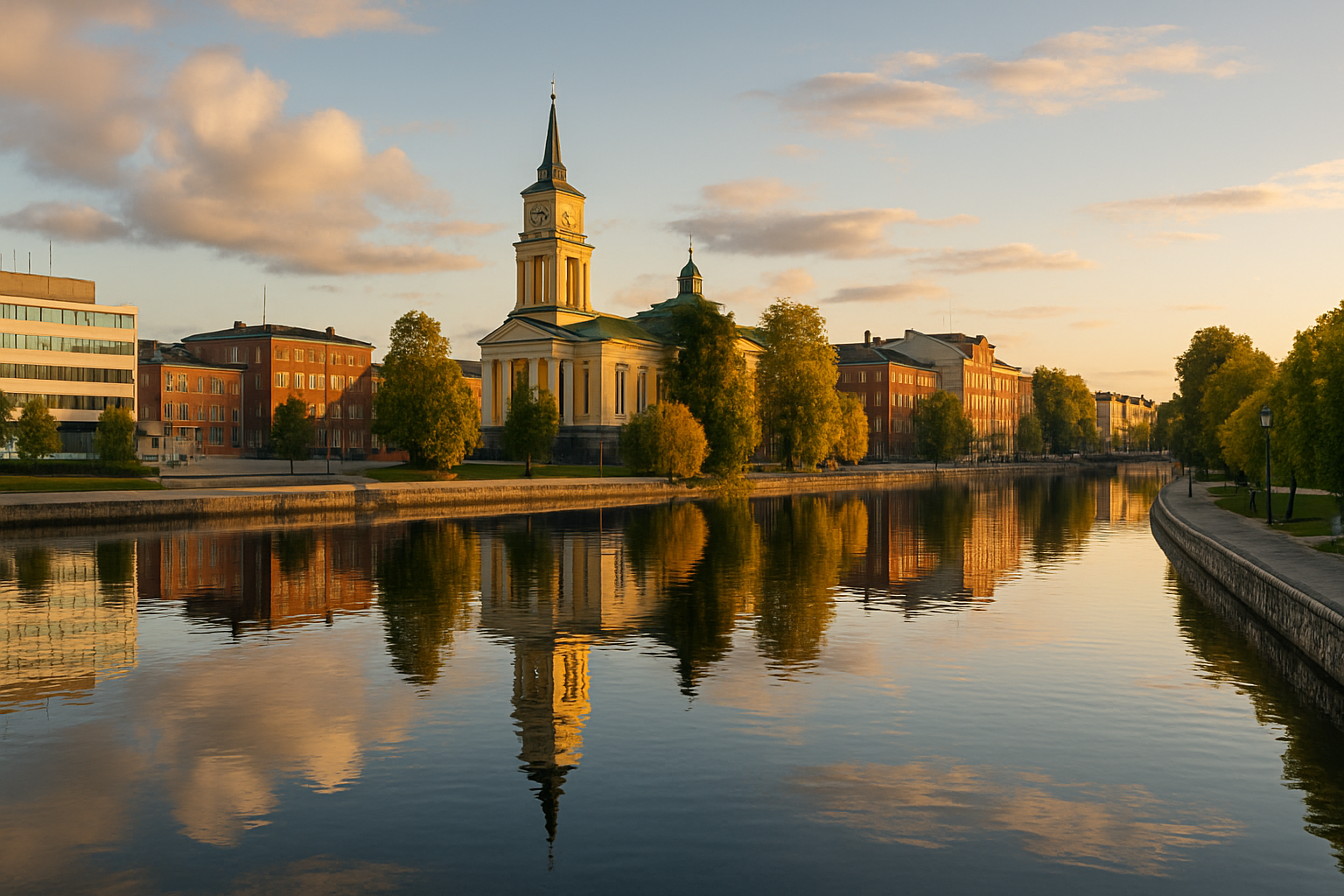
Oulu, Finland
Oulu is the largest city in Northern Finland, built where the Oulujoki River meets the Gulf of Bothnia. Founded in 1605 under Swedish rule, it grew rich on tar, burned and rebuilt in 1822, and reinvented itself in the late twentieth century as a centre of education and technology. It was home to three generations of the Heikki family and their construction firm, until Kalle Heikki's death in 2018 and his son Aldo's departure for Bixbus.
A Town at the River Mouth
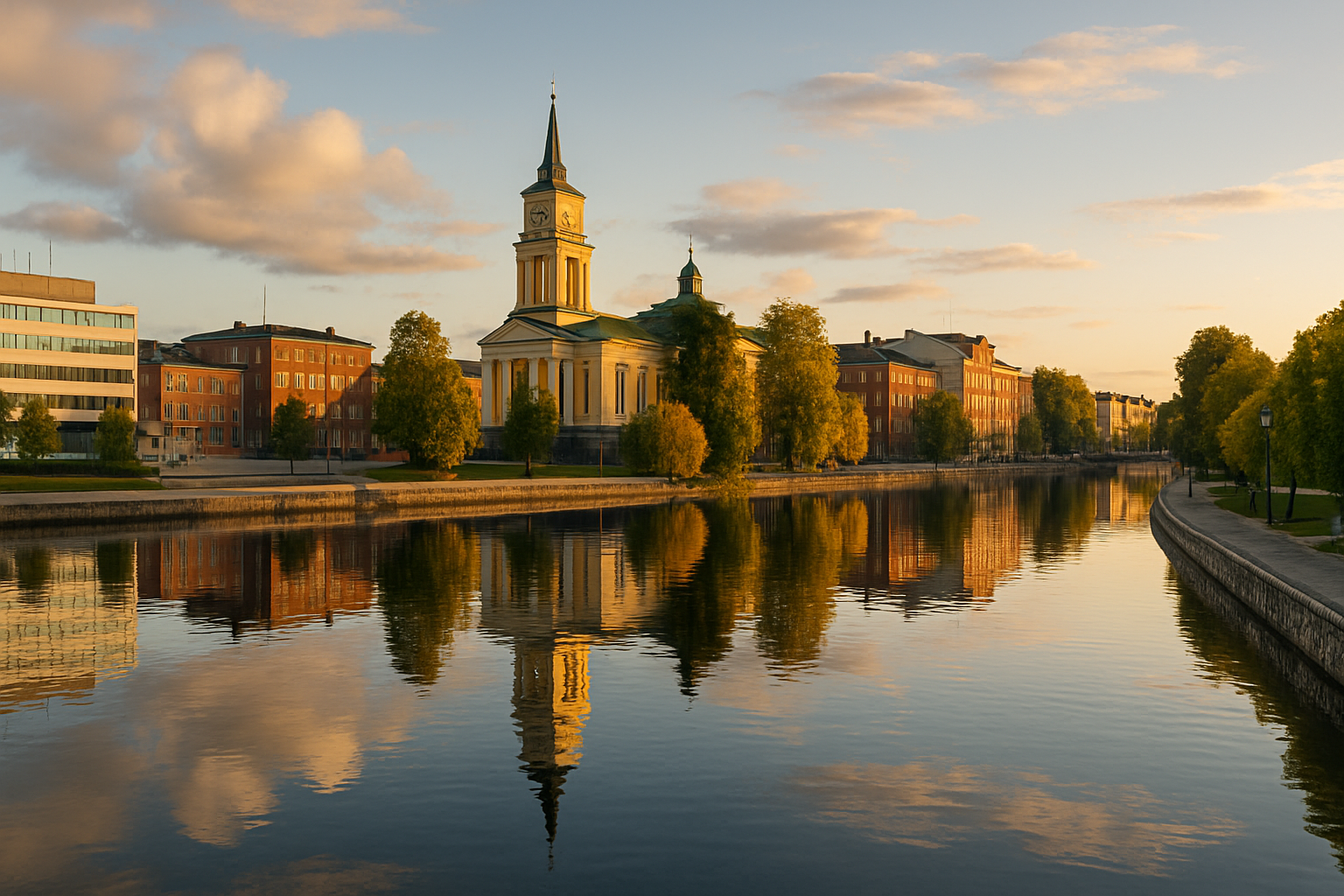
Oulu is a city in Northern Finland, built where the Oulujoki River meets the Gulf of Bothnia, some 170 kilometres south of the Arctic Circle. With a population of around two hundred thousand by the late 2010s, it is the largest city in the north of the country and the regional centre for a vast, thinly settled territory of forest, bog, and lake that stretches east to the Russian border.
The town was founded in 1605 by King Charles IX of Sweden, beside a castle that had been raised on a river island some years earlier to guard the mouth of the Oulujoki. For most of its first three centuries it lived on what the river brought down from the interior. Above all, that meant tar, boiled from pine in forest kilns across the hinterland and floated to the coast in long wooden boats. By the nineteenth century Oulu was among the largest tar exporters in the world, and its merchants grew rich on the trade that caulked and sealed the sailing fleets of Europe.
Fire and Rebuilding
Like most Finnish towns of its age, Oulu was built of wood, and it burned. The great fire of 1822 destroyed most of the town, including its church, and the rebuilding that followed laid out the grid of streets that still forms the centre of the city. The cathedral was restored to designs by Carl Ludvig Engel, the architect of much of Helsinki, and the market square by the water became the heart of civic life.
The decline of tar in the late nineteenth century left the town searching for a new trade, and it found one gradually in timber, paper, and the hydroelectric power of the river. The twentieth century brought war, rebuilding, and the long post-war expansion of a city that was growing faster than it could house itself. The houses, schools, and churches of that period were built by local firms, many of them family concerns started by men who had come home from the front with a trade and little else.
The Technology City
The founding of the University of Oulu in 1958 began a transformation that few in the city foresaw. Over the following decades the university, the technical colleges, and the research laboratories that grew up around them made Oulu one of the centres of the Finnish electronics and telecommunications industry, and for a generation the city's fortunes were closely tied to those of Nokia. The engineers and their families who arrived to work in the new industry changed the character of the city, and the building trades grew with them.
The boom was not continuous. The depression of the early 1990s, which followed the collapse of trade with the Soviet Union, struck Oulu's construction industry with particular force, and many of the family building firms that had survived the post-war decades did not survive those years. The restructuring of the mobile telephone industry two decades later cost the city thousands of jobs and shook its confidence again. Each time, Oulu reinvented itself, more slowly than it had grown.
Light and Dark
Oulu is shaped by its latitude. In midsummer the sun barely sets, and the white nights of June and July draw the city out to its beaches, its islands, and the summer cottages that line the lakes of the interior. In midwinter daylight lasts a few hours, the sea freezes, and an ice road opens across the gulf to the island of Hailuoto. The city's residents cycle through most of the winter on cleared paths, and its market square is watched over by a squat bronze policeman, the Toripolliisi, who has become an unofficial emblem of the city.
Its people have a reputation in the rest of Finland for directness and a certain northern reserve. They are proud of the city, wary of the capital, and inclined to measure people by their work rather than their talk.
The Heikki Family
Among the families whose lives were bound up with the city's growth were the Heikkis, builders for three generations. Aarne Heikki, a carpenter's son, founded Heikki Construction in the post-war years and spent the following decades building houses, schools, and churches across Northern Finland. His son, Kalle Heikki, was born in Oulu on 15 August 1958, served his apprenticeship under his father, and eventually took over a firm that employed some thirty people and had a reputation for work that was slow, expensive, and very rarely needed fixing.
Kalle's children, Aldo and Ella, were born at Oulu University Hospital in 1992 and 1996, and grew up in a timber house in the Hiukkavaara district that their father and grandfather had built together. The family weathered the depression of the early 1990s by taking on repair jobs they would once have turned away. Aldo trained at the Oulu Vocational College and served his own apprenticeship in the family firm, and by his mid-twenties was its site supervisor and its obvious heir.
In 2017 Aldo brought his new wife, the Helsinki artist and cook Leena Mäkinen, to live in the city. Leena found Oulu quieter, slower, and harder to make a place in than she had expected, and spent much of her time there running pop-up dinners in borrowed spaces and teaching cooking to children.
The Firm That Did Not Survive
Kalle Heikki died on 4 May 2018, at the age of fifty-nine. His death exposed debts and overdue payments that he had never disclosed, and Heikki Construction entered a decline that Aldo spent the summer trying to halt. In the late summer of 2018 he accepted a well-paid contract with Killerton Enterprises on what was described to him as a remote residential development, and in late September he left the firm in the hands of its longest-serving foreman, Veikko Laakso. Leena followed him in November. Neither of them returned.
The firm did not survive their absence. It was sold to Veikko Laakso in the autumn of 2019 for considerably less than it was worth. Aarne's widow, Liisa Heikki, died in Oulu on 21 November 2019, at the age of eighty-five. Kalle's widow, Sari Heikki, remained in the city, and her contact with her son thereafter was limited to occasional messages that could not say where he was.