Leena Kristiina Heikki (née Mäkinen)
Leena Kristiina Heikki (née Mäkinen) was born on 2 August 1994 in Helsinki, Finland, the eldest child of museum curator Mikko Mäkinen and teacher Helena Mäkinen. An artist and cook who travelled widely before marrying construction subcontractor Aldo Heikki in 2017, she followed him to Bixbus, Clivilius, in November 2018. There she became a founding member of the Bixbus Event Collective, which she later coordinated, and raised their son, Aukusti, born in 2020.

A Kallio Childhood
Leena Kristiina Mäkinen was born at 06:28 on the morning of 2 August 1994 at Helsinki Central Hospital, the first child of Mikko Antero Mäkinen and Helena Johanna Mäkinen (née Lahtinen). Her parents had married young and settled in a fourth-floor flat in Kallio, the working-class district north of the city centre that was, by the mid-1990s, slowly filling with students, artists, and the kind of cafés that her grandparents' generation regarded with suspicion.
Mikko, born on 10 November 1966, was an assistant curator at the Design Museum, where he specialised in Nordic craft and domestic design. He was an enthusiast rather than an academic, prone to holding forth at the dinner table about the proportions of a chair or the history of a particular glaze, and he took his daughter to work whenever the museum would allow it. Helena, born on 5 April 1968, taught Finnish and Swedish at a secondary school in Sörnäinen and spent her evenings transcribing folk tales she had collected from elderly relatives in Savonia—stories of forest spirits, drowned brides, and lake creatures that she had begun recording as a student and never stopped.
The household that resulted was talkative, cluttered, and frequently short of money. Books and sketches covered every flat surface; arguments about art and language were conducted at volume and forgotten by morning. Leena was a loud, restless child who drew on whatever paper was within reach, including, on more than one occasion, the margins of her mother's manuscripts.
Her brother, Arttu Elias Mäkinen, was born on 19 December 1997, and her sister, Siiri Emilia Mäkinen, on 14 July 2001. Arttu grew into a careful, orderly boy who lined up his toys by colour and later went on to study urban planning; he and Leena loved each other with the wary affection of two people who found each other faintly exhausting. Siiri, seven years younger, became Leena's shadow and, eventually, her closest confidante—a quiet, watchful girl who took up photography as a teenager and was the only member of the family whose opinion of Leena's work she genuinely feared.
The Kitchen as a Canvas
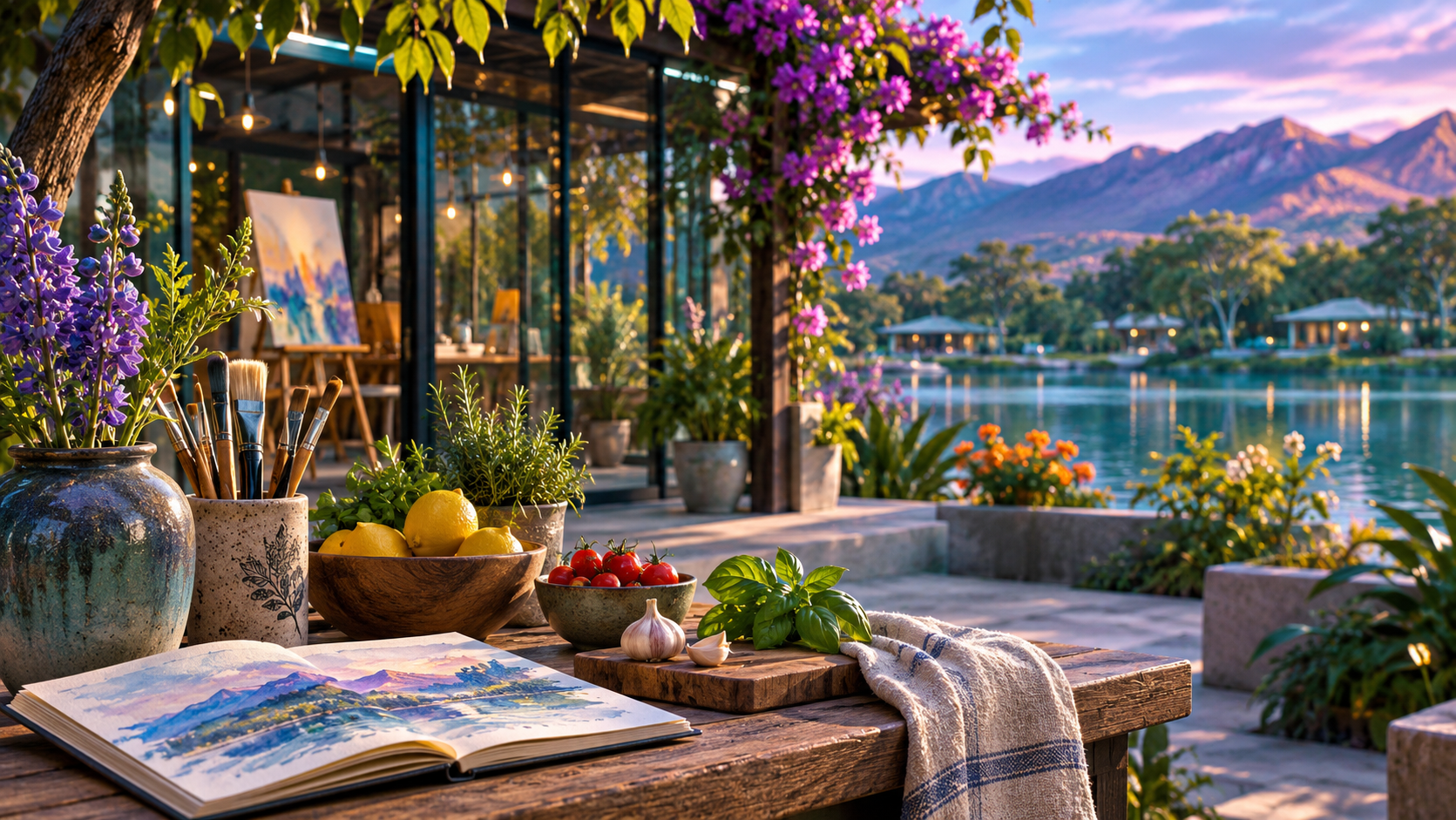
The kitchen was the centre of the flat, and it was there that Leena found her first real medium. Standing on a stool beside her mother, she learned to make karjalanpiirakat, rye bread, and the salmon soup that Helena's own mother had made in a lakeside cottage near Mikkeli. She was less interested in recipes than in what food could be made to do—how a plate could be arranged like a painting, how a meal could carry a story, how the same dish could taste of comfort or of grief depending on who had cooked it and why. By the age of ten she was improvising, combining Finnish staples with whatever she had read about in her mother's library, and producing dinners that were sometimes remarkable and sometimes inedible.
The late 2000s brought harder times. Museum funding was cut after the financial crisis, and Mikko's position was reduced to part-time; he took on freelance cataloguing work for private collectors and grew quieter than his children had ever known him. Helena's school faced cuts of its own. For two years the family economised in ways that Leena, then a teenager, found humiliating at the time and formative in retrospect. She learned to cook well on very little, to make something beautiful out of what was left over, and to distrust any career that depended on someone else's budget.
She attended Ressu Comprehensive School, where she was an uneven student—outstanding in art, literature, and home economics, indifferent to almost everything else. Teachers found her charming and exasperating in roughly equal measure. At sixteen she was accepted into the Kallio Upper Secondary School of the Arts, where between 2010 and 2013 she studied painting, photography, and design, and wrote a final project on the history of Finnish food preservation—fermentation, smoking, drying, and salting—as a record of how a cold country had kept itself alive. Her teachers thought it eccentric. She considered it the most important thing she had written.
Two Years on the Road
After graduating in 2013, Leena left Finland with a backpack, a sketchbook, and enough savings for perhaps three months. She stayed away for two years, working her way through kitchens and markets across southern Europe, North Africa, and Asia. In Barcelona she washed dishes and then cooked in a small bistro in the Gràcia district, learning the patience of Mediterranean slow cooking. In Morocco she spent weeks in the spice markets of Fez, filling pages with drawings of stalls and the faces of the women who ran them. In northern Thailand she cooked on the street beside a family who fed her, taught her, and refused to let her pay for anything.
The travelling was not as romantic as she later made it sound. There were weeks when she slept in hostels she could not afford, a bout of illness in Chiang Mai that left her frighteningly thin, and a stretch of loneliness in the autumn of 2014 that she did not mention in her letters home. She returned to Helsinki in mid-2015 with a head full of ideas, almost no money, and a habit of moving on whenever life threatened to become settled.
Within a year she had left again. In the spring of 2016 she took a seasonal kitchen job at an agriturismo outside Montepulciano in Tuscany, where she learned to make pasta by hand and spent her afternoons painting the vineyards. It was there, in a village café one wet afternoon, that she met Aldo Mattias Heikki, a construction subcontractor from Oulu who was in Italy studying traditional restoration techniques on a centuries-old farmhouse. He was practical, methodical, and slightly bewildered by her; she found him infuriatingly calm and could not stop talking to him. They discovered they were from the same country only after an hour of conversation in English.
Oulu
Leena and Aldo returned to Finland together in early 2017 and married that summer in a small ceremony beside a lake outside Oulu, with Leena's family travelling north for the occasion and Siiri photographing everything. The reception was cooked largely by the bride, who could not be persuaded to let anyone else do it.
The move north was harder than she had expected. Oulu was quieter and slower than Helsinki, its creative scene small and close-knit, and Leena felt for the first time in her life that she had no obvious place. She ran seasonal pop-up dinners in borrowed spaces, taught cooking workshops for children at a community centre, and took on design commissions wherever she could find them, but the income was unpredictable and the work rarely felt like enough. She sometimes resented the solidity of Aldo's life—his family, his firm, his certainty about what he was for—even as she leaned on it.
The Heikki family welcomed her warmly, if a little cautiously. Aldo's father, Kalle Juhani Heikki, was a master builder of the old school, courteous and reserved, who regarded his son's artistic wife as an interesting puzzle. His death on 4 May 2018 struck the family hard. Aldo, who had worked under his father since his apprenticeship, was left grieving and responsible at the same time, and Heikki Construction entered a difficult period as clients drifted and debts surfaced that Kalle had never mentioned. Leena watched her husband retreat into work and silence, and learned that her usual remedy—a crowded table and a good meal—did not reach everyone.
A Contract Without a Map
In the late summer of 2018, Aldo accepted a subcontracting position with Killerton Enterprises on what was described as a large residential development at a remote site. The pay was considerably better than anything available in Oulu, and the firm needed it. The details of the location were vague in ways that he would later recognise as deliberate. Aldo departed in late September and was working in Bixbus by the beginning of October 2018, one of the construction subcontractors brought through to build The Arlington.
Leena followed in November 2018. What she had been told before crossing, and what she understood only afterwards, became one of the few subjects she and Aldo found difficult to discuss calmly. She stepped through into a settlement of tents, shipping containers, and half-graded roads on the edge of a desert beneath a starless sky, with no family beyond her husband, no work, and no clear way of explaining to her parents and siblings where she had gone. Messages to Helsinki, when they could be sent at all, were short and carefully worded, and the replies that came back were full of questions she could not answer.
The first months were the hardest of her life. Aldo worked long shifts on The Arlington, and Leena spent her days in a settlement that had no use for artists and very little for cooks beyond the communal kitchens, where she volunteered because it was better than sitting still. She slept badly, cried more than she let anyone see, and briefly considered asking to be sent home.
What held her was the bonfire. In the evenings, settlers gathered at the Bixbus Bonfire to talk, to grieve, and to keep each other company, and each night the fire was lit with words that the earliest settlers had learned from Chewbathian hunters in the settlement's first weeks: Light the fire. Share the light. Leena began to come most nights. She cooked for the shared meals out of whatever the stores could spare, sketched faces by firelight, and told the old stories her mother had collected, translating them as she went. It was there that she met Lisa Smith, an event planner from Salt Lake City who was quietly giving those evenings a shape—and who, like Leena, refused to accept that a settlement built for survival had no room for anything else.
The Founders' Table
The two women became friends quickly and collaborators soon after, though they were very different in temperament. Lisa planned everything; Leena preferred to improvise and trust the evening to find its own shape. When Lisa took on the organisation of the settlement's first Founders' Day on 23 July 2019, Leena ran the communal meal—a long table laid out along the main road, cooked for far more people than any kitchen in Bixbus had been built to feed. Half the ingredients she had been promised failed to appear, and she rebuilt the menu twice in the final twenty-four hours. The meal was the part of the day that people talked about for weeks.
By the autumn of 2019 Leena was pregnant with her first child. The news brought joy and a new kind of fear: she would be giving birth in a settlement barely a year old, far from her mother and sisters-in-law, with no certainty about what kind of world her child would grow up in. That November, Aldo's grandmother, Liisa Marjatta Heikki, died in Oulu, and neither of them could return for the funeral. Aldo took the loss quietly and hard, and Leena found herself carrying more of the household's emotional weight than she had planned for, at a time when she had less to spare.
When the Bixbus Event Collective was formally established in early 2020, Leena was among its founding members alongside Lisa and the sound engineer Dominic Faulkner. She was by then heavily pregnant and frank about how little she could promise, but she wanted her name on it. The Collective, as she understood it, was the bonfire made permanent, and she intended to be part of whatever it became.
Aukusti
Aukusti Mikael Heikki was born at 09:46 on the morning of 4 April 2020 at the Royal Bixbus Hospital, one of the earliest births at the new facility. The delivery was straightforward. Aldo cried more than Leena did, and was teased about it for years afterwards.
The months that followed were exhausting and isolating in ways she had not anticipated. Bixbus had no grandparents to call on, no established circle of mothers, and very little infrastructure designed with small children in mind. Leena's involvement in the Collective shrank to what could be managed with an infant on her hip: she cooked when she could, designed when she could not, and carried a steady undercurrent of guilt in both directions—towards the Collective when she was at home, and towards her son when she was not. She rarely said any of this aloud. She did, however, begin writing long letters to Siiri that she knew might never be sent, and which recorded more honestly than anything else what that first year had cost her.
Aukusti grew into a curious, talkative toddler who spent much of his early life on the floor of the Collective's rooms at the Bixbus Community Centre, building towers out of offcuts from Jenna Drake's workshop and demolishing them with great satisfaction. Aldo, who had by then moved from The Arlington onto newer residential projects across the settlement, built him a small wooden workbench of his own before he could walk.
Running the Collective
In 2021, when Lisa turned her attention to the newly opened Bixbus Welcome Centre, the day-to-day running of the Event Collective passed to Leena. She accepted the role with more doubt than she let anyone see. She had never managed an organisation, disliked spreadsheets, and was still raising a toddler in a settlement that was growing faster than anyone could keep up with.
She ran the Collective in her own way. Where Lisa had built schedules and contingency plans, Leena built menus, colour palettes, and atmospheres, and trusted the people around her to fill in the logistics. The approach produced some of the Collective's most memorable events and several of its most chaotic. Her contributions to the Winter Light Festival—lantern workshops for children, long tables of shared food beneath strings of handmade lights, and a midwinter meal drawn loosely from the Finnish traditions of her childhood—became fixtures that residents came to regard as essential.
The transition was not easy. Lisa remained the Collective's founder and public face, and decisions had a way of drifting back to her whether or not she was in the room. Leena found the shadow difficult to work in and said so more than once, sometimes more sharply than she intended. The friction never became a rupture. Over time the two women settled into an arrangement built on mutual respect rather than easy agreement, with Leena running the organisation and Lisa carrying its relationships—and with a shared understanding, rarely spoken, that each could do something the other could not.
As Bixbus's arts community grew large enough to organise for itself, Leena found herself caught between two loyalties. The Bixbus Arts Collective represented painters, performers, and makers who did not always appreciate being treated as entertainment for occasions planned by others, and Leena, who still painted when she could find the time, understood their complaint better than most. She spent a good deal of energy smoothing disputes over credit and programming, and occasionally wondered aloud which side of the argument she was meant to be on.
A Life Built on Borrowed Ground
By 2025, Bixbus had grown into a city of millions, and the Heikkis' life within it had settled into a recognisable shape. The family lived in a modest apartment in one of the newer residential developments that Aldo had helped to build. Aldo had established himself as one of the settlement's more respected subcontractors, though the long hours and the stress of an ever-expanding city brought back the anxiety and back pain that had troubled him in Finland, and Leena watched over his health more closely than he liked.
Aukusti started school in 2025 and announced that he intended to be a builder, a cook, and an artist, in no particular order. He spoke Finnish at home and English everywhere else, and asked questions about Helsinki that his parents found increasingly difficult to answer.
Contact with Earth remained intermittent. Leena's parents had come to understand, in broad terms, where their daughter had gone, though Mikko in particular never fully reconciled himself to it. Siiri remained her closest link to home, and the letters between the sisters—some sent, many not—formed a record of two lives running on parallel tracks in different worlds. Arttu, by then an urban planner in Tampere, asked detailed questions about how Bixbus was laid out that Leena could not answer and occasionally passed on to Aldo.
Leena continued to run the Event Collective, to cook for far more people than any kitchen had been built to feed, and to paint in the margins of a life that left little room for it. She was not always content. There were evenings when she missed the sea at Helsinki, the smell of a sauna, and the particular quality of Finnish summer light so acutely that she could not explain it to anyone in Bixbus. But each year on 23 July she went to the small dusk gathering at the site of the original bonfire, stood with the handful of people who still remembered how it had begun, and spoke the old words as the fire caught.