Kalle Juhani Heikki
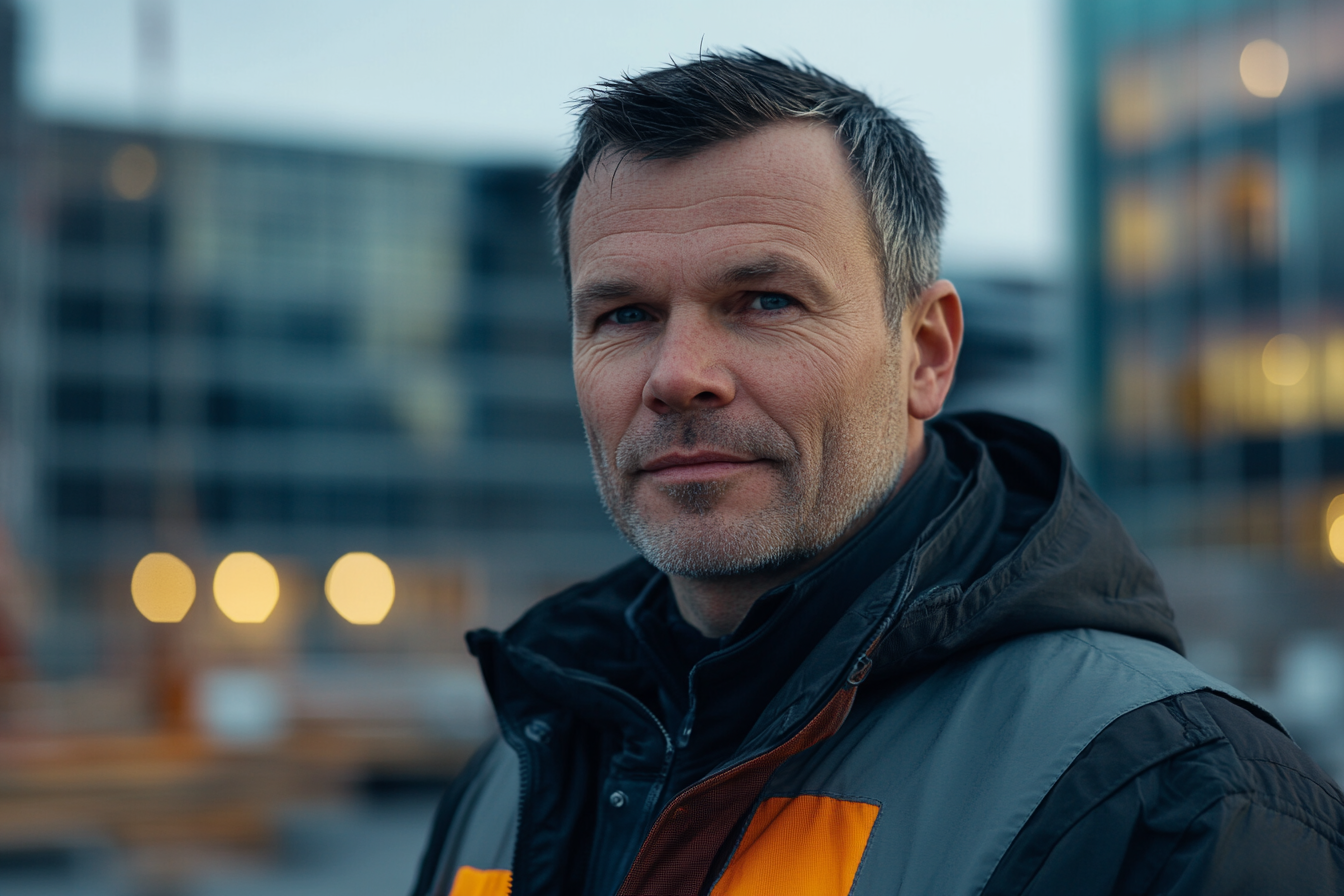
Kalle Juhani Heikki (1958–2018) was a Finnish master builder, born in Oulu to builder Aarne Heikki and seamstress Liisa Heikki (née Rantala). Trained at the Oulu Technical Institute and in his father's firm, he married teacher Sari Koivunen in 1981, had two children, Aldo and Ella, and steered Heikki Construction through the depression of the early 1990s. Courteous, reserved, and uncompromising about quality, he died suddenly of a heart attack in May 2018, leaving debts he had hidden from his family.
The Builder's Boy
Kalle Juhani Heikki was born on 15 August 1958 in Oulu, Finland, the second child and elder son of Aarne Matti Heikki and Liisa Marjatta Heikki (née Rantala). His father, born on 28 March 1932 in Raahe, was a carpenter's son who had come to Oulu as a young man and founded a small building firm in 1956, taking whatever work the post-war city offered. His mother, born on 2 June 1934 in Kempele, was a seamstress who took in sewing and embroidery commissions at the kitchen table and kept the household accounts with a precision her husband never matched.
The family lived in a timber house on the outskirts of the city that Aarne had built himself, with a workshop at the back where he kept his tools and did his own projects in the evenings. Kalle's elder sister, Maarit Helena Heikki, had been born on 5 January 1955. Two more children followed him: Elina Katariina Heikki on 19 July 1961, and Petri Antero Heikki on 3 December 1966.
Money was rarely plentiful. Aarne's firm grew slowly through the 1960s, and there were years when the building trade slackened and he took on repair work and small jobs to keep his men paid. The children were expected to help. Maarit minded the younger ones, Elina carried her mother's finished work to customers, and Kalle, from the age of seven or eight, spent his Saturdays and school holidays at his father's heels on whatever site Aarne was working.
Learning to Read Plans
The person who did most to shape him as a builder was not his father but his father's elder brother, Mikael Heikki, a carpenter who worked for the firm and had more patience than Aarne could spare. Mikael taught Kalle to read a set of plans before he was ten, sitting with him over drawings spread across the workshop bench and making him explain each line back. Aarne taught by example and by silence. Mikael taught by asking questions, and Kalle never forgot the difference.
Summers were spent at the cottage that Aarne built in the 1960s on the shore of a lake near Pudasjärvi, some eighty kilometres north-east of Oulu. Aarne added to it every year—a sauna, a jetty, a boathouse—and the children were put to work on each in turn. Kalle learned there to fish, to split wood, and to judge whether a joint would hold by running a thumb along it. He would bring his own children to the same lake a generation later and teach them the same things.
He was a quiet, serious boy, strong in mathematics and technical drawing and indifferent to most other subjects. When he was twelve, a winter storm brought down part of a timber footbridge near the family home, and Aarne took him along when his crew was called out to rebuild it. Kalle spent three days watching his father work out how to brace the span in freezing water, and decided, by the end of it, that he would do nothing else.
Training and Service
At sixteen he enrolled at the Oulu Technical Institute, where between 1974 and 1978 he trained in carpentry and building construction, learning both the traditional log and timber-frame methods his father used and the concrete and steel that were replacing them. His instructors found him slow to speak and quick to spot a mistake. He finished near the top of his year and went straight into his father's firm.
His apprenticeship was interrupted almost at once by national service, which he completed with the Kainuu Brigade at Kajaani between 1978 and 1979. He found the army tolerable, the winters long, and the company of men who talked constantly exhausting. He came back to Oulu with a sergeant's stripes, a lasting dislike of being told what to do by people who did not know how to do it, and a determination to learn every trade the firm practised.
He spent the next several years doing exactly that. Aarne held him to a harder standard than any other man on his crews, and Kalle met it without complaint and largely without conversation. By his mid-twenties he was running sites of his own.
His siblings went their own ways. Maarit trained as a teacher and moved to Helsinki, where she eventually became the head of a primary school. Elina became a nurse in Oulu's community health service and, in later years, the one who looked after their parents. Petri joined the firm in the mid-1980s and left it in 1991 after a falling-out with Kalle over how a job should be priced, going north to work in forestry management in Lapland. The brothers did not speak for almost three years, and when they did, neither mentioned the argument again.
Sari
Kalle met Sari Anneli Koivunen in the spring of 1980 at a dance at the student union of the University of Oulu, where she was training to be a teacher. She had come down from Kuusamo, near the Russian border, and was brisk, well-read, and entirely unimpressed by his silences. He asked her to dance three times before she agreed. They married in the summer of 1981, when he was twenty-two and she was twenty-one.
In the early 1980s Kalle and his father built a timber house for the young couple in the Hiukkavaara district of the city, working on it in the evenings and at weekends over the better part of two years. It was the first house Kalle built entirely for his own family, and he went on fixing and improving it for the rest of his life. Sari took a post at a primary school on the city's eastern side and kept it for most of her working life.
The marriage was steady rather than easy. Sari read constantly and talked about what she read; Kalle listened, nodded, and went back to the workshop. She ran the household, the accounts, and most of the family's social life, and she resented, more often than she said, how much of it was left to her. They argued about his hours more than anything else. He showed affection by fixing things—a sticking door, a draughty window frame, the shelves she had asked for twice—and it took her some years to learn to read that as the language it was.
Children were slow to come. The couple spent most of the 1980s waiting, and in 1988 Sari lost a pregnancy in its fourth month. Neither of them spoke of it outside the family. Kalle dealt with it the way he dealt with most things, by working longer hours, and Sari dealt with it largely alone, a pattern that both of them recognised and neither of them changed.
The Calculator at the Kitchen Table
Their son, Aldo Mattias Heikki, was born at Oulu University Hospital at 04:17 on 15 March 1992. Kalle was thirty-three. The birth came at the worst moment of the early 1990s depression, which followed the collapse of Finland's trade with the Soviet Union and struck the construction industry in Northern Finland with particular force. Contracts vanished, clients went bankrupt owing money, and firms that had survived for decades closed within months.
Heikki Construction survived, but only just. The firm shed more than half its staff, and Kalle and his father took on repair jobs and small renovations they would once have turned away. Kalle spent many nights at the kitchen table with a calculator and a stack of invoices, and his son would later remember the way conversations stopped when he came into the room. The strain showed in Kalle's health: by his mid-thirties he had high blood pressure, which he treated mainly by ignoring it.
His daughter, Ella Krista Heikki, was born at Oulu University Hospital at 15:42 on 7 September 1996, by which time the worst was over. Aarne stepped back from the firm gradually through the second half of the decade, and by the end of it Kalle was running Heikki Construction in all but name. His father never formally handed it over. He simply came to the office less often, and then not at all.
A Man Whose Work Spoke for Him
Under Kalle the firm rebuilt itself slowly to some thirty people and took on houses, schools, churches, and a growing number of restoration projects on older public buildings across Northern Finland. It was not a large firm, and it did not try to become one. Its reputation in Oulu was for work that was slow, expensive, and very rarely needed fixing, and Kalle was content with that reputation to the point of stubbornness. He turned down contracts he thought would force him to cut corners and lost several to cheaper rivals as a result.
The work he was proudest of was a restoration, carried out over two summers in the early 2000s, of a timber parish church north of the city that had been built in the 1840s and patched badly ever since. Kalle insisted on replacing rotten members with hand-cut timber of the same species and section, and spent more of the firm's money on the job than the parish ever paid. He never said so publicly. He did take each of his children to see it when it was finished, and stood in the nave for a long time without speaking.
He was courteous, reserved, and convinced that a man's work should speak for him because he had no intention of doing so himself. His crews respected him and mostly liked him, though few would have said they knew him well. He rarely praised anyone. When something was done badly, he said nothing at all, and the silence was usually enough.
He was a more distant father than he meant to be. He took Aldo to sites from the time the boy could walk and brought both children to the cottage every summer, where he taught them to fish and to split wood as Aarne had taught him. But he left the patient explaining to his own father, as Mikael had once done for him, and it was Aarne rather than Kalle whom Aldo came to regard as his teacher. Ella argued with Kalle from an early age in ways her brother never dared, over whether a house should be built to last or to delight. Kalle listened to both of his children and rarely took sides.
The Next Generation
In 2008, at sixteen, Aldo began a formal apprenticeship with the firm under his father. Kalle held his son to a standard he applied to no one else, just as Aarne had held him, and the older tradesmen watched the boss's son for any sign of favouritism and found none. Kalle did not notice, or chose not to notice, that Aldo was working himself into back pain and sleepless anxiety in the effort to meet that standard. By 2012 Aldo had completed his apprenticeship and become one of the firm's site supervisors, and Kalle began, without ever saying so, to think of him as his successor.
In 2009 Kalle was diagnosed with type 2 diabetes. He took the medication, ignored most of the dietary advice, and went on spending long days on site. Sari nagged him about his health with increasing frustration and decreasing effect.
Ella, by then grown and more interested in design than in building, left Oulu to study architecture in the south. Kalle drove her and her belongings the length of the country, said almost nothing for most of the journey, and spent the evening before he left assembling a drawing desk in her student flat from timber he had brought in the back of the van. She found a note in the drawer some weeks later. It said, in its entirety, that the joints were glued as well as screwed and that she was not to let anyone tell her otherwise.
Aarne Heikki died on 14 September 2015, at the age of eighty-three. Kalle organised the funeral, delivered a eulogy of five sentences, and spent most of the following month alone at the cottage near Pudasjärvi repairing a boathouse that did not need repairing. It was the closest his family ever saw him come to open grief.
What He Did Not Say
The firm's difficulties in the last years of Kalle's life were largely of his own making, and almost entirely hidden. In the middle of the decade, under pressure from larger and cheaper competitors, he took on a fixed-price renovation of a care home in Kempele that ran badly over its budget. Rather than admit the loss, he borrowed against the firm, delayed payments to suppliers, and allowed two large debts owed to the firm to go uncollected while he chased new work to cover the gap. He told no one, not his son, not his foreman, and not his wife.
In 2016 Aldo spent several months in Tuscany studying restoration methods, and came home the following year with a wife: Leena Mäkinen, a talkative artist and cook from Helsinki whom Kalle regarded, from the first, as an interesting puzzle. They married in July 2017 at the family cottage near Pudasjärvi, where Kalle spent much of the reception talking to Leena's father about the proportions of the cottage's timber framing. He was proud of his son that day in a way he did not express, and he spent the evening with a glass he barely touched, watching the light on the water.
Leena cooked for the family whenever she and Aldo came to dinner, and Kalle, who had eaten the same handful of dishes for most of his life, ate everything she put in front of him without comment and asked for more. He never told her he liked her. He did build her a set of kitchen shelves for the flat she shared with Aldo, measured to the height of her reach, and fitted them himself one Saturday morning while she was out.
Sari noticed the signs without understanding them. He slept badly, took telephone calls in the yard, and lost weight he could not explain. In the spring of 2018 he began to complain of a tightness in his chest that he dismissed as heartburn and refused to see a doctor about. She booked an appointment for him in April, and he cancelled it for a site meeting.
The Fourth of May
Kalle Juhani Heikki died on 4 May 2018, at the age of fifty-nine. That morning he had driven out to inspect roof work on a school renovation the firm was carrying out in Kiiminki, north of the city. Shortly after ten o'clock he collapsed in the school yard while talking to the firm's longest-serving foreman, Veikko Laakso. Laakso began resuscitation while one of the roofers called for an ambulance. Kalle was pronounced dead at Oulu University Hospital shortly before eleven. The cause was a heart attack.
He was buried beside his father at Intiö Cemetery in Oulu later that month, after a funeral attended by his family, most of his crews, and a great many people for whom he had built houses over four decades. Aldo spoke for longer than his father would have.
Within weeks, as Aldo and Sari went through the firm's books, the extent of what Kalle had kept from them became clear: the overrun on the Kempele contract, the borrowing, the unpaid suppliers, and the debts that had never been chased. Sari, who had been married to him for almost thirty-seven years, learned more about her husband's last three years from his ledgers than she had from him.