Finland
Finland is a Nordic country of forests and some 188,000 lakes, ruled by Sweden for six centuries and by Russia as a Grand Duchy until it declared independence in 1917. It survived civil war, two wars with the Soviet Union, and the depression of the early 1990s, and reinvented itself as a technology and education leader. It was home to the Heikki family of Oulu and the Mäkinens of Helsinki, whose children Aldo and Leena left in 2018 for Bixbus.
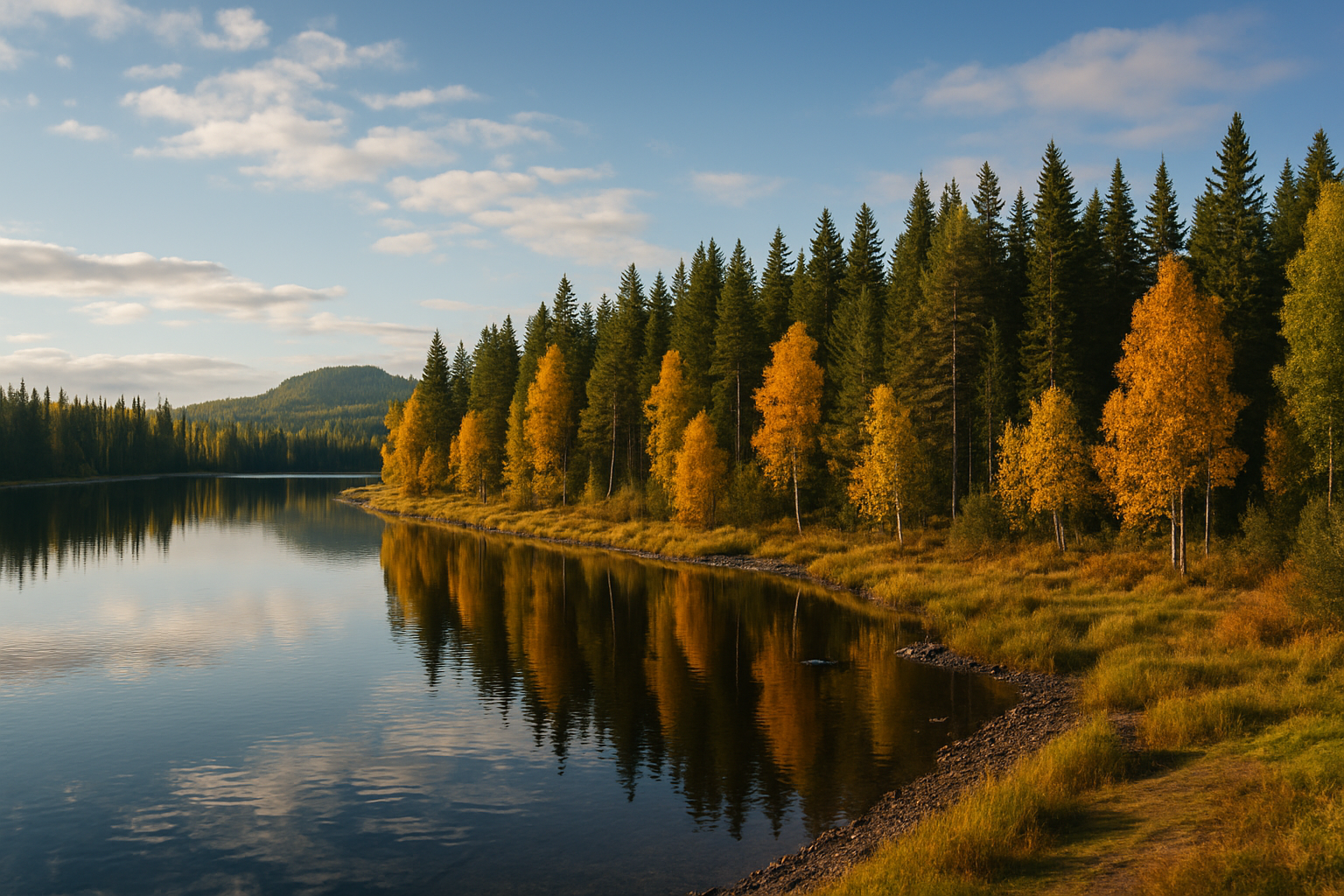
Lake and Forest
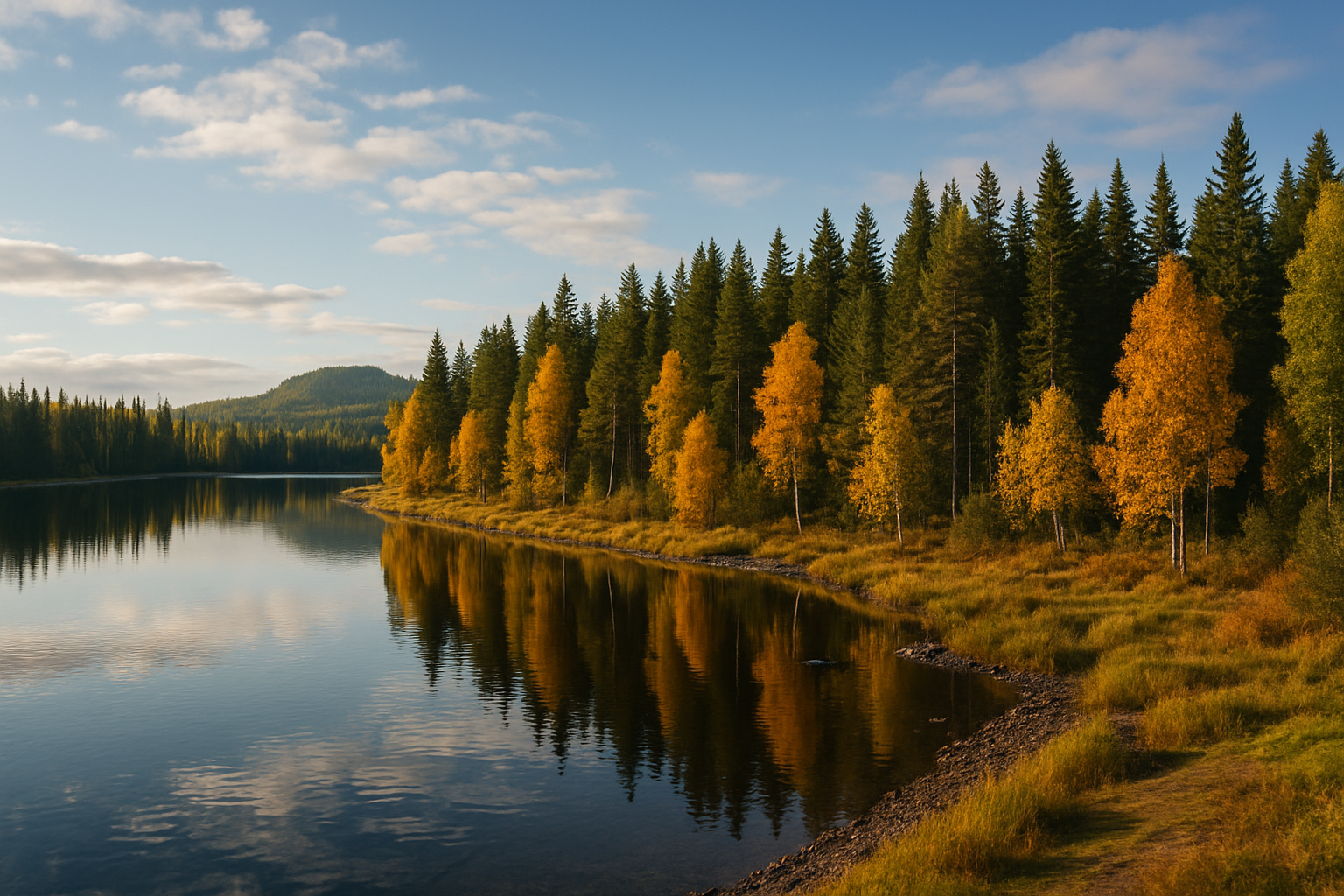
Finland is a Nordic country in north-eastern Europe, bordered by Sweden to the west, Norway to the north, and Russia along a frontier of more than thirteen hundred kilometres to the east. The Gulf of Bothnia and the Gulf of Finland enclose it on the west and south. Its territory covers some 338,000 square kilometres, roughly three-quarters of it forest, and contains around 188,000 lakes, from the great waters of the Saimaa system in the south-east to countless nameless ponds in the bogs of the north. A quarter of the country lies above the Arctic Circle.
It is a large country with few people. By the 2020s its population was around five and a half million, concentrated heavily in the south around Helsinki, Espoo, Tampere, and Turku, with Oulu the only city of any size in the north. Finnish is the first language of the great majority, and Swedish, spoken by a coastal minority of around five per cent, is the second official language. In Lapland the Sámi peoples keep their own languages and a reindeer-herding culture far older than the state.
The climate shapes almost everything. Winters are long and dark, with weeks in the far north when the sun does not rise at all, and summers are short and bright, with nights that never fully darken. The Finnish year turns on that contrast, between months spent indoors and the brief season of lakeside cottages, saunas, and midsummer fires when the whole country seems to move outdoors at once.
Six Centuries Under Sweden
For most of its recorded history Finland was not a state but the eastern half of the Swedish kingdom. Swedish rule spread across the south and west from the twelfth and thirteenth centuries, bringing the Catholic Church and later, in the sixteenth century, the Lutheran Reformation. Mikael Agricola, the bishop of Turku, produced the first books printed in Finnish in the 1540s, giving the language its written form.
Turku was the old capital and the seat of the first university. Along the Bothnian coast, Swedish kings founded a line of trading towns in the seventeenth century, among them Oulu in 1605 and Raahe in 1649, which grew on the export of tar, timber, and furs from the interior. Finland was also, repeatedly, the battleground on which Sweden fought Russia, and the eastern provinces changed hands more than once before the final war of 1808 and 1809.
The Grand Duchy
In 1809 Sweden ceded Finland to the Russian Empire, and the country became an autonomous Grand Duchy with the Tsar as its Grand Duke. It kept its own laws, its Lutheran church, and, in time, its own currency, the markka. The capital moved from Turku to Helsinki, closer to St Petersburg, where Carl Ludvig Engel designed the neoclassical centre that still surrounds the Senate Square.
The nineteenth century saw a national awakening. Elias Lönnrot gathered the folk poetry of Karelia into the epic Kalevala, first published in 1835, and the Finnish language rose steadily against the Swedish of the educated classes. By the turn of the century, as Russia tried to tighten its grip, composers such as Jean Sibelius and painters such as Akseli Gallen-Kallela had given the nation a cultural identity of its own. In 1906 Finland became the first country in Europe to grant women both the vote and the right to stand for parliament.
Independence and Civil War
Finland declared independence on 6 December 1917, in the turmoil that followed the Russian Revolution. Within weeks the new state was at war with itself. The Finnish Civil War of 1918 set the conservative Whites, led by Carl Gustaf Emil Mannerheim, against the socialist Reds, and ended in a White victory after some three months of fighting. Around 36,000 people died, many of them in reprisals and in the prison camps that followed. The bitterness divided Finnish communities for a generation.
Winter War and Continuation War
In November 1939 the Soviet Union invaded. The Winter War lasted a little over three months, through one of the coldest winters of the century, and the Finnish army held out against forces many times its size before accepting peace terms in March 1940 that cost the country most of Karelia. In 1941 Finland went back to war against the Soviet Union alongside Germany, in what Finns called the Continuation War, and lost again in 1944.
The armistice required Finland to expel the German troops still in the north. In the Lapland War that followed, the retreating Germans burned much of Finnish Lapland as they went, including Rovaniemi and most of Kuusamo. More than four hundred thousand Karelians, around a tenth of the population, had to be resettled elsewhere in the country, and Finland paid heavy war reparations to the Soviet Union, largely in ships and machinery, until 1952. The country kept its independence and its democracy, which few of the Soviet Union's other neighbours did. The quality Finns credited for it was sisu, a stubborn endurance that the word captures better than any translation.
Rebuilding
The decades after the war were spent rebuilding. Hundreds of thousands of standard-plan timber houses went up across the country for veterans and evacuees, and small building firms founded in those years, many of them by men who had learned their trades in wartime, grew with the towns around them. The Helsinki Olympics of 1952 marked a return to the wider world, and the reparations industries became the base of a modern engineering economy.
Under President Urho Kekkonen, who held office from 1956 to 1982, Finland walked a careful line between East and West, trading heavily with the Soviet Union while remaining a market democracy. Critics abroad called it Finlandisation. Finns mostly called it survival. The country urbanised quickly in the 1960s and 1970s as people left the farms and forests for the cities, and a comprehensive school system and a Nordic welfare state took shape in the same years.
Depression and Reinvention
The collapse of the Soviet Union in 1991 took Finland's largest trading partner with it. Combined with a banking crisis at home, it brought on the worst economic depression in the country's peacetime history. Output fell by more than ten per cent, unemployment approached twenty per cent by 1994, and the construction industry was among the hardest hit. Thousands of small businesses failed. Those that survived often did so on the strength of their owners' savings, and families felt the strain for years.
The recovery transformed the country. Finland joined the European Union in 1995 and adopted the euro in 2002. Nokia, an old paper and rubber company, became for a decade the largest mobile phone manufacturer in the world, and cities such as Oulu and Espoo reinvented themselves around technology and research. Finnish schools, which gave every child the same education and trusted highly trained teachers to deliver it, became an international model. The Nokia boom faded after 2010, and the years that followed were slower and harder, but the country kept its reputation as one of the most stable, best educated, and least corrupt in the world. In 2023, following Russia's invasion of Ukraine, Finland joined NATO, ending more than seventy years of formal military non-alignment.
Sauna and Silence
Finnish life has its own habits. There are more than three million saunas in a country of five and a half million people, and the sauna is less a luxury than a household necessity, the place for washing, for thinking, and for conversations that would not happen anywhere else. Summer cottages by lakes, many of them built by hand by the families who use them, are an institution. Coffee is drunk in quantities that lead the world.
Finns have a reputation, which they cultivate with some pride, for reserve. Silence in company is not considered awkward, small talk is rationed, and praise is given sparingly and meant when given. The reputation is not the whole truth, but it is not a myth either, and it ran deep in families like the Heikkis of Oulu, where a man's work was expected to speak for him.
Finland in the Storiverse
Finland's place in the Clivilius Storiverse rests largely on two families. In Oulu, the Heikki family built houses, schools, and churches across the north for three generations. Aarne Matti Heikki, born in Raahe in 1932, founded the family firm in 1956 as part of the post-war rebuilding. His son Kalle steered it through the depression of the 1990s and kept it running until his sudden death in May 2018. In Helsinki, Mikko and Helena Mäkinen raised a daughter, Leena, who met Aldo Heikki in Tuscany in 2016 and married him beside the family's lake cottage near Pudasjärvi the following summer.
In September 2018, with the family firm in debt, Aldo accepted a Killerton contract and stepped through the portal to Bixbus, one of the tradesmen recruited from dozens of countries to build The Arlington. Leena followed in November. Neither returned. Sari Heikki in Oulu and the Mäkinens in Helsinki came to know their children and their grandson, Aukusti, only through delayed messages relayed by Killerton. None of them knew where the messages came from.
Finland also left its mark beyond its borders. The sculptor Teppo Matti Jaskelain was born in Turku in 1962 and emigrated to Australia with his family at the age of eleven, carrying a northern sensibility into a very different country.