Christophorus Johan Aveskamp
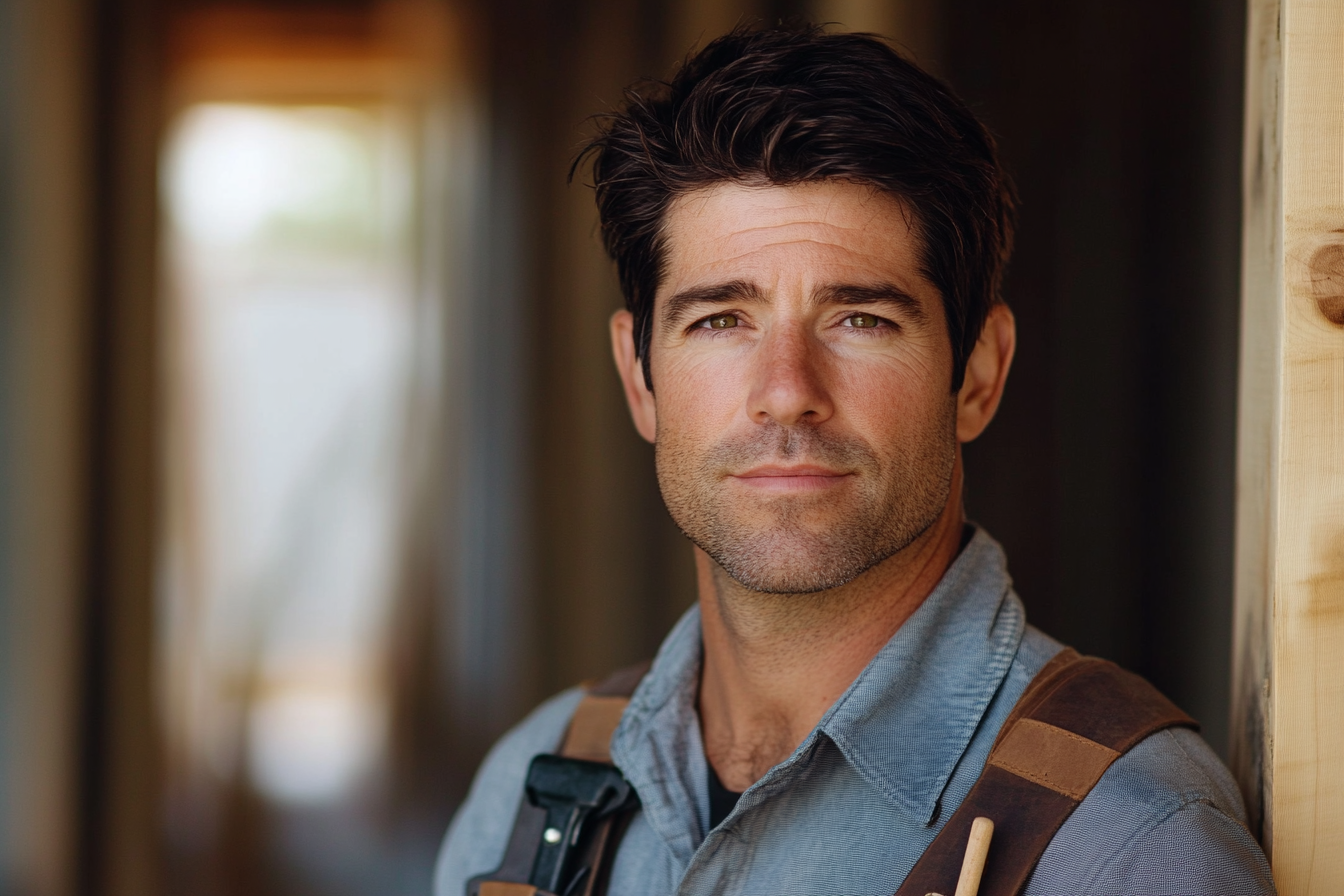
Christophorus Johan Aveskamp was born on 22 March 1991 in Santa Fe, New Mexico, the elder twin of Sergio Aveskamp and son of geologist Thomas Aveskamp and teacher Marisol Aveskamp (née Ramirez). Trained in construction management, he restored adobe in New Mexico and historic joinery in Deventer before crossing to Bixbus, Clivilius, in February 2019 as finish foreman on The Arlington. He later ran his own finishing crew, built a life with botanist André Villeneuve, and with him adopted their son, Lucas, in 2023.
The First Twin
Christophorus Johan Aveskamp was born at 03:41 on the morning of 22 March 1991 at St Vincent Hospital in Santa Fe, New Mexico, eleven minutes before his twin brother, Sergio Miguel Aveskamp. His own delivery was the easier of the two. He was weighed, wrapped, and placed on his mother's chest while the doctors turned their attention to the second twin, and for the rest of his life he would be the one who arrived first and caused no trouble about it.
His father, Thomas Willem Aveskamp, born on 9 June 1959, was a field geologist with the New Mexico Bureau of Geology, the grandson of Dutch immigrants from Overijssel who had farmed in Iowa before drifting south-west. His mother, Marisol Aveskamp (née Ramirez), born on 14 February 1963, taught at a primary school on the city's south side and came from a large Hispano family whose roots in northern New Mexico ran back further than anyone could trace. The boys' names reflected the two sides of the household: Christophorus and Johan from the Aveskamp line, Sergio and Miguel from the Ramirez.
The family lived in a low adobe house in the Casa Solana neighbourhood, with a cottonwood in the yard and a kitchen that belonged, by general agreement, to Marisol and her relatives. The twins were the couple's only children, and from the beginning they divided the house between them. Sergio took the kitchen and the noise. Christophorus took the yard, the garage, and his father.
Rocks and Timber
Thomas was a patient, literal man who spent weeks at a time in the Jemez Mountains and along the Rio Grande rift, and from the age of six Christophorus went with him whenever he could. He learned to walk a dry arroyo in silence, to read the layers in a road cut, and to understand that the ground beneath any building had a history of its own. Thomas rarely explained anything twice. Christophorus rarely needed him to.
He was building things almost as soon as he could hold a hammer. At nine he built a lean-to against the garage from fence offcuts; at thirteen, a treehouse in the cottonwood that survived three summers of monsoon storms and his mother's objections. He was a quiet, absorbed child, more comfortable with tools than with other children, and he found the Ramirez family's Sunday lunches—twelve to forty relatives, all talking at once—something to be endured rather than enjoyed. His brother ran those gatherings. Christophorus usually ended up in the yard with his father.
The twins were close as small children and drifted apart in adolescence. They shared a bedroom until they were twelve and fought about it constantly, and by their early teens they had settled into separate lives under the same roof: Sergio in the drama club and the kitchen, Christophorus on his father's field trips and in the workshop at Santa Fe High School, where a carpentry teacher named Ray Montoya let him stay after hours and taught him to cut a dovetail by hand.
The Thing Not Said
Christophorus understood that he was gay at around fourteen, and decided almost at once that no one would ever know. It was a decision made less from fear of any one person than from an instinct for keeping things level and quiet, and it shaped the rest of his adolescence. He dated a girl from his chemistry class for most of a year and felt nothing but guilt about it.
In the spring of 2008, a few weeks after the twins' seventeenth birthday, Sergio came out to the family in the kitchen. Christophorus was in the next room. He listened to his mother cry, then to her silence, and watched that silence settle over the house for three months while Marisol went to Mass, taught her classes, and did not speak of it. His father said little, as always. The extended family learned in pieces, and some of them responded better than others.
What Christophorus took from those months was a lesson his brother never intended to teach. If the household could go that quiet over one son, he would not give it a second reason. He said nothing, supported Sergio in ways that were mostly practical—driving him to friends' houses, covering for him with their grandmother—and buried his own truth more deeply than before. He would keep it buried for almost a decade.
Albuquerque and the Adobe Years
The twins graduated from Santa Fe High School in 2009 and went in opposite directions. Sergio went north to Colorado. Christophorus went south to the University of New Mexico in Albuquerque, where between 2009 and 2013 he studied construction management. He was a steady, unremarkable student in the lecture theatre and an exceptional one on site, and he spent his summers on placements with restoration contractors in Santa Fe, working on the adobe buildings that gave the old city its character.
The work suited him. Adobe was unforgiving and slow, and restoring it well meant understanding how a wall had been built a century earlier and why it was failing now. After graduating in 2013 he joined one of those contractors full time and spent two years repairing mission churches, old merchant houses, and walls that had been patched with cement by people who did not know better. He was good at it, and well regarded, and increasingly restless.
Outside work he climbed, mostly in the Sandia Mountains and at the crags near Los Alamos, often alone. He also learned Spanish properly, having grown up hearing it at his grandmother's table without ever quite speaking it, and was pleased to discover that his aunts treated him differently once he could answer them back. He had no relationships worth the name. His mother began to ask, carefully, whether there was anyone, and he began to find reasons to visit less often.
Deventer
In 2015 Christophorus went to the Netherlands. The decision was partly practical—a restoration joinery firm in Deventer, Bouwhuis Restauratie, had a reputation that reached as far as New Mexico, and he wrote to them on the strength of it—and partly something he did not examine too closely. Deventer was the town in Overijssel that his father's family had left more than a century earlier. He was twenty-four, and he wanted to be somewhere that no one knew him.
Between 2015 and 2018 he worked on the timber interiors of Deventer's Hanseatic merchants' houses and on church fittings across Overijssel and Gelderland: panelling, staircases, window frames, and the long, exacting work of matching new oak to old. He learned Dutch, slowly and then fluently, and lived in a narrow flat above a bicycle shop off the Brink. His colleagues found him reserved, meticulous, and almost impossible to hurry. He found in Dutch joinery the same thing he had found in adobe: a craft built on patience and on respect for whoever had done the work before.
It was in Deventer, in 2017, at the age of twenty-six, that he finally stopped hiding. He told no one in New Mexico. He began, cautiously, a relationship with Joost van Dijk, an architect in Zwolle, which lasted a little over a year and ended badly. The fault was mostly Christophorus's. He had learned to live openly in a country where no one he had grown up with could see him, and he did not know how to let anyone close enough to see the rest.
He came home to Santa Fe for Christmas most years and found it harder each time. Sergio, then working in Los Angeles, noticed that his brother seemed more closed with every visit. Their grandmother, Dolores Ramirez, died in January 2017, and Christophorus flew home for the funeral, stood at the back of the reception his brother had organised, and left two days earlier than he had planned.
The Contract
In late 2018, after the relationship with Joost had ended and his contract with Bouwhuis had run its course, Christophorus was approached through a recruitment agency in Rotterdam about a finishing contract with Killerton Enterprises on a large residential development at a remote site. The pay was very good, the details vague, and the start date soon. He told his family that he had taken an overseas construction job and would be out of contact for long stretches. Marisol asked where. He told her he was not entirely sure, which was true.
He crossed into Bixbus on 2 February 2019. The settlement he found was barely six months old, half tents and half building site, on the edge of a desert beneath a sky with no stars. He learned on his first day that no one but a Guardian could cross back to Earth, and that the journey he had just made could not be undone. He was appointed finish foreman on The Arlington, responsible for the carpentry crews who would fit out its interiors. He arrived angry, though the anger had nowhere useful to go, and he did what he had always done with feelings he could not manage. He went to work.
Finishing The Arlington
The Arlington was the most ambitious thing Christophorus had ever seen attempted. Ground had been broken on 1 October 2018, and by the time he arrived both twenty-storey towers were climbing towards their full height, steel going up at two floors a week under three round-the-clock shifts, with the glass curtain wall following a few storeys behind. His task was the interiors: partition framing, doors, stairs, and the joinery that would turn bare concrete decks into homes. His crew of finish carpenters—among them Charlie Danyer, Clayton Myers, Boyd Drake, Bryden Castro, Akira Nakamura, and Stefan Novak—came from half a dozen countries and almost as many traditions, and several arrived in Bixbus after he did.
He ran them the way he had been run in Deventer: quietly, exactingly, and with no tolerance for work that would need doing twice. Some of the crew respected him for it. Others found him cold. Akira Nakamura, a joiner from Kyoto whose standards matched his own, became the nearest thing he had to a friend on site. Boyd Drake, older than Christophorus by nearly twenty years and missing his family in Seattle, called him "the Dutchman" until the name stuck across the whole project, and Christophorus stopped correcting it.
The pace was unlike anything he had known. In Deventer a single staircase could take a season; at The Arlington the interior partitions began on the lower floors of Tower A on 14 February, and his crews worked their way upward close behind the services trades while the steel was still rising above them. He argued at first with the project's schedulers, Aldo Heikki in particular, over sequences he was certain could not work. They worked. The two men came out of those arguments with a grudging respect for one another that neither expressed.
He stood with the rest of the crews when Tower A topped out on 5 March 2019, and again when Tower B followed on 27 March. Through the spring and early summer the finishing trades moved floor by floor through both towers. Tower A received its first residents on 1 July, and the project was declared complete on 21 August 2019, eight weeks ahead of schedule and without a single lost-time accident. On the day the first families moved in, Christophorus walked the finished corridors of Tower A, running his hand along a stair rail his crew had fitted, unable quite to believe what they had done.
Bringing Sergio
Within days of crossing, Christophorus had begun writing to his brother. The first messages were short and evasive. By the end of February he had told Sergio the truth, or as much of it as he could put into words, and asked him to come. The settlement needed people to manage accommodation, supplies, and the daily logistics of feeding and housing hundreds of tradespeople, and Christophorus had already put Sergio's name forward without asking him.
He would later admit that he did it partly for the settlement and partly for himself. He was lonely in a way he had not been since adolescence, and Sergio was the one person whose company he had never had to earn. Sergio took three weeks to decide and crossed in March 2019. Within days the brothers were arguing bitterly about what Christophorus had told him and what he had left out, above all how plainly he had explained that there would be no going back, and for several weeks they did not speak. The reconciliation, when it came, was gradual and largely unspoken. By the summer they were eating together most evenings in the canteen tents.
They did not talk about the other thing. Christophorus had still not told his brother that he was gay, and Sergio, who had come out a decade earlier and assumed he would have noticed, had not guessed.
André
After The Arlington, Christophorus moved from one residential project to the next as the settlement's construction programme accelerated. In 2020 his crew was assigned to fit out the glasshouses and research laboratories being built for the botanical programme at Clivilius National University. It was there that he met André Villeneuve, a botanist from Quebec who was working on the cultivation of Earth crops in Clivilian soil and who had firm opinions about how his benches should be built.
They argued about the benches for most of a week. André was quick, funny, and entirely unintimidated by Christophorus's silences, and he noticed things about him that other people did not. By the end of the project they were seeing each other. Christophorus told Sergio a few weeks later, over most of a night, and learned for the first time how badly his brother had wanted to be told and how much it hurt him to realise why he had not been. Sergio apologised for things he had not known he had done. Christophorus told him, with some impatience, that none of it had been his fault, and meant it.
Telling his parents took longer. He wrote to them in 2021, a long letter that he redrafted eleven times, and waited nearly a month for the reply. Marisol's answer was shorter than his letter and warmer than he had expected. She said that she had made one mistake with one son and did not intend to make it with the other. Thomas added a line at the end about a fault line he had been mapping near Abiquiú, and then a second line saying that he was glad.
A House with Benches
Christophorus and André moved in together in 2022, into an apartment in one of the newer residential developments that Christophorus's crews had fitted out. He rebuilt most of its interior within a year. André filled the balcony and every windowsill with plants that had no business surviving in Bixbus, several of which did not, and the arguments about where things should go became the background noise of a household that both of them, to their mutual surprise, found settling.
They were not an easy couple. Christophorus was slow to share anything and slower to apologise; André was quick to anger and quick to forgive, and found his partner's habit of withdrawing into work maddening. They separated briefly in the spring of 2022, a few weeks before the move, and came back together after a conversation in which Christophorus said more about Deventer and Joost than he had ever said to anyone. The move went ahead as planned.
By then Christophorus was running his own finishing crew and had begun taking on apprentices from among the settlement's younger arrivals. He trained them as Ray Montoya had trained him in the workshop at Santa Fe High School: by letting them make mistakes, then making them undo every one.
Lucas
In 2023 Christophorus and André adopted Lucas, a baby boy. The decision had been André's long before it was Christophorus's, and Christophorus agreed to it with more doubt than he let his partner see. He did not know whether he would be any good at it. He had been raised by a father who loved him in silence and a mother who had once gone silent at the wrong moment, and he was afraid of repeating both.
The first year was harder than either of them had anticipated. Lucas slept badly, André's work at the university took him away for long days, and Christophorus found himself doing more of the night shifts than he had expected while still running a crew by day. He became, almost without noticing, a careful and patient father. He built Lucas a cot, then a high chair, then a set of wooden blocks cut from offcuts of Arlington oak that he had kept for four years without knowing why.
In the same year Sergio and his partner, Damien Russo, adopted their daughter, Isla. The twins became fathers within months of each other, and each accused the other of copying him. The two families began eating together most Sundays, in whichever apartment had the larger table that month, with Sergio organising the meal and Christophorus quietly fixing whatever in the apartment had broken since the week before.
Building in a Hurry
By 2025 Bixbus had become a city of millions, and Christophorus had become a veteran of its construction industry—one of the original finishing foremen from The Arlington, still working, with a reputation for interiors that took longer than anyone wanted and outlasted everything around them. He was not always happy with what the city asked of him. The pace of construction rewarded speed over care, and he turned down more work than his crew would have liked because he would not put his name to rooms he knew would fail within a decade.
He still climbed when he could, on the escarpments beyond the city's edge, though less often and never alone now that Lucas was old enough to ask where he had gone. He still spoke Dutch to himself when he was concentrating, and sometimes to Lucas, who had begun to answer back in a mixture of Dutch, French, and English that delighted André and bewildered everyone else.
By 2026 he was thirty-five, a partner and a father, the elder twin by eleven minutes in a city that had not existed when he turned twenty-seven. He wrote to his parents more often than he once had. And on Sunday evenings, when the two families sat down together and Sergio held court at the head of the table, Christophorus could usually be found at the other end of it, saying very little, with his son asleep against his shoulder.