Aaron Matthew Smyth
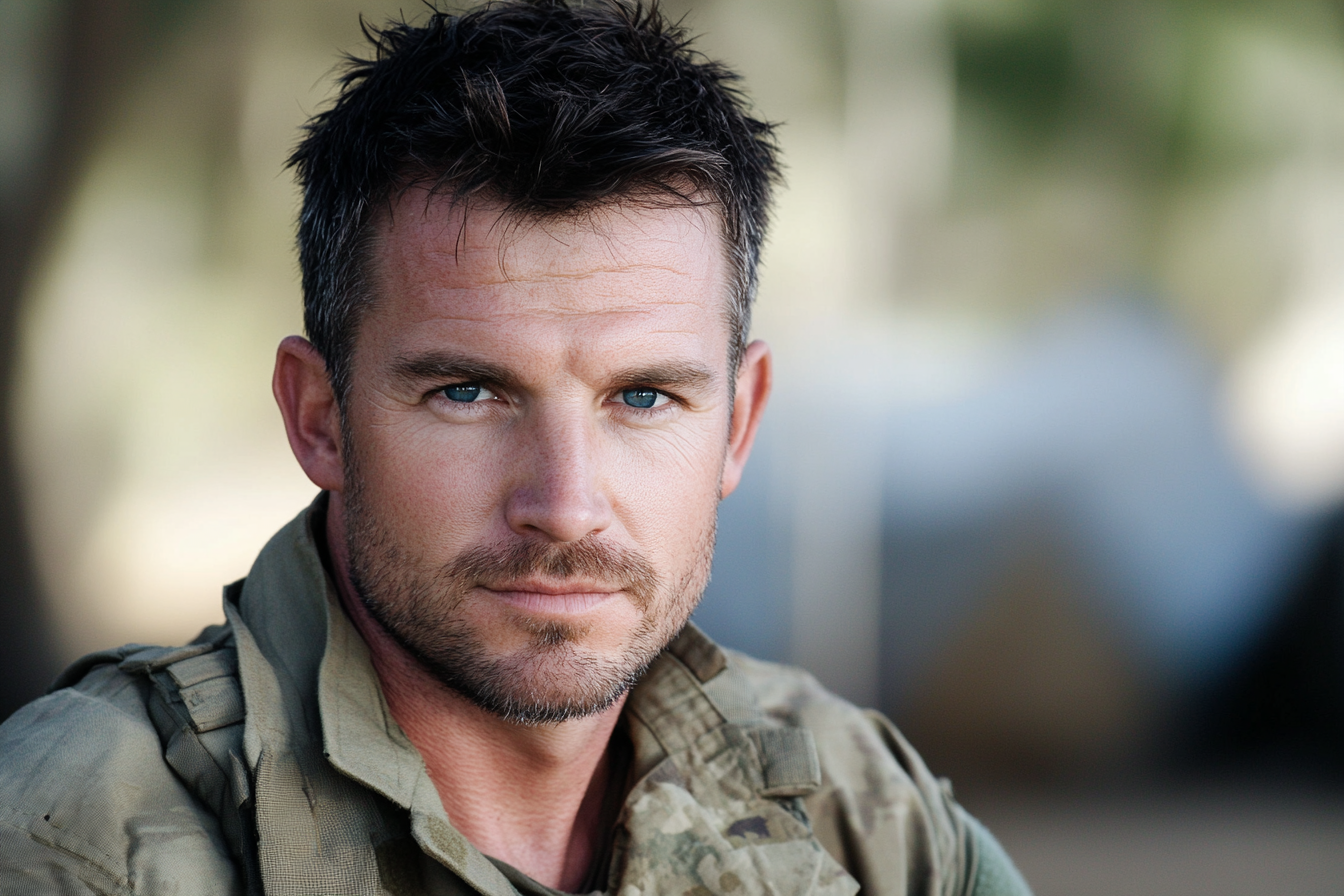
Aaron Matthew Smyth (b. 12 May 1980, Hobart) was a former Australian Army logistics officer and Tasmanian emergency planner whom Luke Smith brought into Bixbus on 15 August 2018, leaving his two children behind in Hobart. He put forward his old friend Brett Wilson for the Singleton tent raid, ran the Bixbus Tent Community alongside him, and later worked with the Bixbus Housing Authority and, quietly, the Clivilius Secret Service.
A Dock Worker's Eldest
Aaron Matthew Smyth was born on 12 May 1980 at the Royal Hobart Hospital, the eldest of three children of Malcolm James Smyth and Linda Marie Smyth (née Costello). His father, born in Hobart in 1955, worked the wharves at Macquarie Point for most of his life, loading and unloading the container ships and fishing boats that kept the city's waterfront busy. His mother, born in Launceston in 1957, was a nurse on the surgical wards of the Royal. They lived in a weatherboard cottage in Glenorchy, close enough to the river that Aaron grew up with the smell of it.
A brother, David Malcolm Smyth, followed on 22 February 1983, and a sister, Rachel Anne Smyth, on 5 December 1985. Aaron was the responsible one from the start, partly by temperament and partly because the household needed one. Malcolm worked shifts that changed week to week; Linda worked hers; and by the time he was ten Aaron was the one who knew which parent would be home when, who needed collecting from where, and what was in the freezer for tea.
Malcolm was a big, quiet man who drank more than he should on Friday nights and never raised a hand to any of them. He was proud of his eldest in a way he could not say aloud and expressed it instead by taking him down to the docks on Saturday mornings to watch the cranes. Aaron loved those mornings. He liked the order of the place: the way every container had a number and a destination, the way a ship could be emptied and filled in a day if every man knew his job. It was his first lesson in logistics, though he would not have called it that for another fifteen years.
He attended Hobart College for his final two years of schooling after Glenorchy High, and was a competent student who was good at mathematics and physical education and indifferent to most else. Weekends were spent sailing dinghies on the Derwent with a club in Sandy Bay, a sport he took to with a seriousness that surprised his parents, and later running long distances along the river and up the slopes of kunanyi. He had a handful of friends and wanted no more. University did not appeal to him. He wanted something with rules he could learn and then master.
Kapooka and Duntroon
In February 1998, three months before his eighteenth birthday, Aaron enlisted in the Australian Army. His mother cried; his father shook his hand. He completed recruit training at Kapooka, near Wagga Wagga, and was posted to a transport unit, where his instructors quickly noticed that he was not only fit and disciplined but unusually good at seeing how a complicated movement of people and equipment ought to fit together. In 2000 he was selected for officer training and entered the Royal Military College at Duntroon.
He was older and more experienced than most of his cadet intake, and less impressed by the place than they were. He graduated in 2002 and was commissioned as a lieutenant in the Royal Australian Army Ordnance Corps, the logistics corps whose work he already understood better than most of its junior officers. Within months he was in East Timor, running resupply convoys out to the infantry companies holding the western border district.
It was there, on a river crossing south of Maliana in the wet season, that he met Private Brett Thomas Wilson, two years his junior, an infantryman from Darwin whose section had been tasked to escort Aaron's trucks. One of the trucks bogged to its axles. The two men spent most of the night winching and digging and swearing alongside each other, and shared a cigarette at dawn when it finally came free. The friendship that followed was an unlikely one by Army standards, and both of them were careful with it. An officer and a private did not drink together in public. They talked instead over tailgates, wrote to each other when they were apart, and met on leave where nobody from either of their units would see.
Movements and Withdrawals
The years that followed were the best of Aaron's career and, in hindsight, the beginning of its cost. He served in Papua New Guinea and the Middle East, managing supply chains in places where a late delivery could mean real harm. In 2006 he was part of the team that coordinated the evacuation of Australian nationals from an escalating conflict zone, and received a commendation for it that he never mentioned to anyone outside the family. The same deployment kept him overseas for Brett's wedding in Singleton in October that year. He sent a hand-written card instead and felt worse about it than he let on.
He had married in Hobart the previous year. Claire Louise Bennett was a paramedic with the Tasmanian ambulance service, two years younger than him, quick-witted and entirely unimpressed by the Army. They met at a friend's barbecue during one of his leave periods and married within eighteen months. Their son, Bryn Malcolm Smyth, was born on 17 March 2008, and their daughter, Jackie Linda Smyth, on 9 September 2010. Aaron was present for neither birth. He was in the Middle East for the first and in Afghanistan for the second.
From 2008 he served as a senior logistics officer, and much of his work in those years was in Afghanistan, first keeping forward positions supplied and later managing the withdrawal of Australian forces from parts of the country: the long, unglamorous job of counting, packing and moving everything an army leaves behind. He was very good at it. He also came home from each rotation a little more removed from the people waiting for him.
His father died suddenly on 3 August 2012, of a heart attack on the wharf. Brett Wilson flew down from Singleton for the funeral and stood at the back of the church, and afterwards the two men drank whisky in a waterfront hotel bar until well past midnight. Aaron told Brett that night that he was thinking of leaving the Army. He did so in 2013, after fifteen years of service. It was the last time the two men saw each other on Earth.
Civilian Weather
Aaron came home to Hobart and took a position as an emergency logistics coordinator with the Tasmania State Emergency Service. The work suited him on paper. He planned evacuation routes, designed temporary shelter arrangements for displaced communities, and spent the bushfire seasons of the mid-2010s moving people, water, generators and bedding into places that needed them in a hurry.
What did not suit him was everything else. Civilian life had none of the structure he was used to, and family life, which he had been absent from for most of a decade, had established its routines without him. Claire had raised two children largely alone and had stopped expecting him to fit into the gaps. He tried, earnestly and awkwardly, and found that he was better at managing a flood evacuation than a school morning. The marriage ended in 2016. It was not a dramatic divorce. Claire kept the house in Lenah Valley and the children lived with her, and Aaron rented a small cream-brick house at 27 Wallcrest Road in Berriedale, in the northern suburbs not far from where he had grown up, and saw them every second weekend and one evening a week.
He left the SES the same year and set up as an independent logistics consultant, working for councils, private firms and the occasional government agency on infrastructure and risk planning. He was competent, well paid and restless. He heard through mutual acquaintances that Brett had been promoted and was still at Singleton, and meant to ring him. He did not. By early 2018 he was sleeping badly, running further than was good for him, and wondering what exactly he was for.
A Contract Without an End Date
He had known Luke Smith since the winter of 2016. Luke and his partner, Jamie Greyson, lived at number 2, on the corner at the bottom of the hill, too far down and round the bend to be seen from Aaron's windows. The friendship began, as Aaron's rarely did, by accident: Luke's two Shih Tzus, Henri and Duke, escaped through a gap in a fence one morning and Aaron caught them at the end of his run. Over the next two years the two men settled into an easy, irregular acquaintance of beers on Luke's back deck, borrowed tools and long conversations in which Luke talked and Aaron mostly listened.
Luke was dreamy, distractible and given to strange remarks about worlds and voices that Aaron put down to temperament. Aaron liked him anyway. He was one of the few people in Hobart who never asked Aaron what he was going to do next.
In late July 2018 Luke changed. He was suddenly busy and secretive, Jamie was nowhere to be seen, and on his morning runs Aaron passed delivery vans at the bottom of the hill more often than seemed reasonable, and then police cars. He did not ask. It was not his habit to ask.
Late on the night of 3 August he saw the fire. He was awake when an orange glow rose above the rooftops below the bend and smoke began to drift up the hill. He knew which house stood on that corner before he reached his front gate. By the time he had run down the hill in the cold, fire crews were working on number 2, police were holding back the neighbours, and the house was well alight. There was no sign of Luke or Jamie. Aaron rang Luke's mobile three times from the footpath and got nothing, sent a text, and stood watching until well after midnight, not knowing whether he was waiting for news of survivors or of bodies.
Luke rang him the following afternoon. He would not say where he was, only that he and Jamie were safe and that he could not explain over the phone. Two evenings later he turned up at Aaron's door, exhausted and smelling faintly of smoke, sat at the kitchen table and, over that night and several more across the following week, told him the truth. He needed someone who knew how to house and supply large numbers of people in hard conditions, and he did not know anyone else who could. Aaron's call from the footpath, Luke admitted later, was what had made him think of it.
Aaron understood, in the sense that he could repeat back what he had been told, that he would be going somewhere he could not easily return from. Luke, who had not been honest with everyone he brought through, was honest with him about that. What Aaron did not do, then or later, was fully believe it. He was a man who had spent his life inside systems that always, eventually, sent you home. He told Claire that he had taken a long logistics contract overseas, somewhere remote with poor communications, and that he did not know when he would be back. He took Bryn and Jackie out for dinner the weekend before he left. He did not tell them it might be the last time, because he did not quite think it would be.
On 15 August 2018, Luke opened his portal in the narrow hallway of Aaron's house at number 27 and brought him through. Aaron left the house as he always did, tidy, with the heater laid, food in the fridge and the calendar on the wall. The moment he understood that he was not going back came perhaps an hour later, standing in the dust of the settlement watching Luke cross back to Earth without him. He never decided whether he had been misled or had misled himself, and over the years he gave both answers depending on the day.
Three Days Before the Tents
Bixbus in mid-August 2018 was fewer than a hundred settlers living in a hodgepodge of camping tents, cars, motorhomes and improvised shelters, with water carried from the river and no one in particular responsible for where anyone slept. Aaron spent his first two days walking it, counting people, counting tents and making lists. On the second evening he told Paul Smith that the settlement could not grow without proper shelter, and that proper shelter on the scale it needed did not exist anywhere in Bixbus.
When the question arose of where such shelter might come from, it was Aaron who remembered an old friend at the School of Infantry in Singleton, a sergeant with access to Army stores and a reputation for keeping his mouth shut. He had not spoken to Brett Wilson in six years. He gave Eli Smith enough private detail about their time together to make him believable, and then waited, unsure whether Brett would agree or would ever forgive him for asking.
In the early hours of 18 August, Aaron stood with Paul Smith and a small crew of settlers beside the portal and received the stores from the raid on the Singleton warehouse as Eli carried them through. At 2.55 a six-wheeled cargo truck came through behind them with Brett at the wheel. Aaron's first words to his friend in six years were a complaint about the truck's headlights. The two men were seen laughing for some time afterwards, which those who later came to know Aaron regarded as close to unprecedented.
Coordinator of Canvas
From the first day, Aaron and Brett held full authority over what became the Bixbus Tent Community, and the division of labour settled itself without discussion. Aaron planned and allocated; Brett built, organised work crews and enforced order. Three tents were up by that evening and all fourteen, with their 252 cots, by the afternoon of 21 August. Aaron spent that afternoon laying out zones, a central supply area, wash areas and a line of latrines, turning rows of canvas into a planned camp. Three days later he posted the first written rosters for water carrying, cooking and latrine duty, and spent the following weeks enforcing them with a patience that some residents found reassuring and others found infuriating.
He was a careful, unsentimental administrator. He kept lists of who slept in which tent, ledgers of tools and stores, and a running count of beds. He was not warm with residents, and he knew it, and he left the warmth to Brett and later to Brett's wife, Angela, a nurse who arrived with their daughter, Chloe, on 27 August. Within a fortnight Angela had talked him into giving her a tent of her own for first aid. He came to rely on her judgement more than he admitted.
On 6 September 2018 he was one of the small team waiting at the portal site when the first construction workers for The Arlington came through from a secure Killerton Enterprises site on Earth, many of them still wearing the virtual reality headsets they had been told were part of a simulation. It fell to Aaron, as the Tent Community's coordinator, to walk the disoriented and furious new arrivals to the rows and find them cots. It was the first of many such walks.
Seven Hundred Beds and a Third Pair of Hands
In October 2018 the Killerton construction crews began arriving in numbers, and the Tent Community's population roughly doubled, from around three hundred and fifty to around seven hundred, within days. The raid's tents had long since been filled, and Aaron spent that month improvising shelter from whatever could be brought through or built, while food, water and sanitation came close to failing. On 15 October Dominic Hayes, a British former humanitarian logistics coordinator, was brought in to help, and the three of them rebuilt the camp's systems from the ground up.
Aaron and Dominic understood each other almost immediately, in the way of two people who had spent careers moving supplies into places that did not want them. They argued about method constantly and agreed about almost everything that mattered. In November, when an outbreak of gastroenteritis swept through the eastern rows, it was Angela who fought Aaron and Brett to move the latrines further from the water supply, and Aaron who conceded first.
The waves of displaced settlers from failed settlements elsewhere in Clivilius began the following year. On 5 March 2019 around six hundred arrived within a single day, many of them exhausted, sick or grieving, and Aaron spent two nights allocating space by lantern light while Brett's crews put up shelter in the dark. He recorded every name he could. It was the kind of night he had been trained for, and he was better at it than almost anyone in Bixbus.
Quiet Work
When the Clivilius Secret Service was founded in April 2019, its people approached Brett and Aaron together, looking less for spies than for credibility with the settlements beyond Bixbus. Brett took on the visible work, the journeys to Chewbathia and the introductions. Aaron took on the invisible part. For several years he quietly planned the movement of stores and people for CSS operations, worked out supply routes between settlements, and kept the kind of careful ledgers that nobody else wanted to keep. He held no rank and asked for none, and very few people in Bixbus ever knew he did it.
His main work, from June 2019, was with the newly founded Bixbus Housing Authority. As permanent housing began to rise, the Authority took on the task of moving residents out of the Tent Community, and Aaron became one of the people who made that process work in practice: matching households to new homes, managing waiting lists that ran into the thousands, and coordinating with construction teams over when buildings would actually be ready, as opposed to when they had been promised.
It was in this period that he made his last real attempt to stay connected to his children. Twice in his first year he had asked Luke Smith to carry letters to Bryn and Jackie, written as if from an overseas contract. One reply came back, from Jackie, eight years old and full of questions about when he was coming home. After that, as the CSS tightened control over what crossed between worlds, the letters stopped. Aaron did not press. He told himself it was for their sake. He was never sure that was true.
A City That Outgrew Him
Through the early 2020s, as the Tent Community shrank and Bixbus became a city, Aaron moved from running things to advising on them. He took a strategic advisory role with the Housing Authority, consulting on urban expansion and disaster preparedness, and from 2021 helped the newly opened Bixbus Welcome Centre design its intake processes for new arrivals. Much of what he had improvised in the tents in 2018 survived in their procedures, usually without his name attached.
He and Brett saw less of each other than they had in the first frantic year. They remained close in the way they always had been: rarely in conversation, reliably in a crisis. Aaron was a regular, if quiet, guest at the Wilsons' table, and Chloe Wilson, who had decided within a day of arriving that she liked him, treated him as a kind of uncle long after she had outgrown the habit.
He lived alone in a small apartment in one of the city's newer districts. He ran long distances across the country beyond the city, sailed on the Bixbus River when he could borrow a boat, and played chess against anyone who would sit still for it. He read histories of frontier settlements on Earth, trying to understand how places like Bixbus had grown, and what had happened to the people who had built them once the building was done.
After the Tents
When the last residents left the Tent Community on 17 March 2025, Aaron went down to watch the final tents come down. Brett was supervising the work himself. The two men stood together for a while and said very little. Aaron left before the end.
By 2026 he was forty-six, respected and somewhat distant, a man whose skills had been indispensable to Bixbus in its first years and were now useful in the way that experienced advice is useful. He worked steadily and was good at what he did, but he often wondered what his place was in a city that no longer needed someone to tell it where everyone would sleep. He had never quite found a sense of belonging in Bixbus, and he was no longer sure he expected to.
He thought about his children most days. Bryn turned eighteen that year and Jackie sixteen, and he had no idea what either of them looked like, or what they had been told, or what they believed had happened to their father. He kept Jackie's single letter in a folder with his commission papers and his father's funeral notice. Of all the things he had organised in his life, it was the one departure he had not planned properly, and he never forgave himself for it.